


Your Home For Tactical Tips, Strategies and Ideas for Your DTC - AI Workflows



Meet The Hosts

Thomas Moen
Thomas is a well-known figure in Norwegian marketing and recently built a fully AI automated agency that supports over 70 unique clients. Connect with Thomas on LinkedIn.

Will Sartorious
Will is CEO of SelfMade, a performance creative agency that pairs AI-driven production with senior strategy and media buying for DTC brands across wellness, beauty, food & bev, and lifestyle.
Andrew Foxwell
Andrew is co-founder of Foxwell Digital and the Foxwell Founders Community, a high-level, exclusive membership for the best in digital marketing.
Join The AI DTC WTF Newsletter
Stay up to date with the latest trends in AI for your DTC agency along with when new releases and special episodes drop.
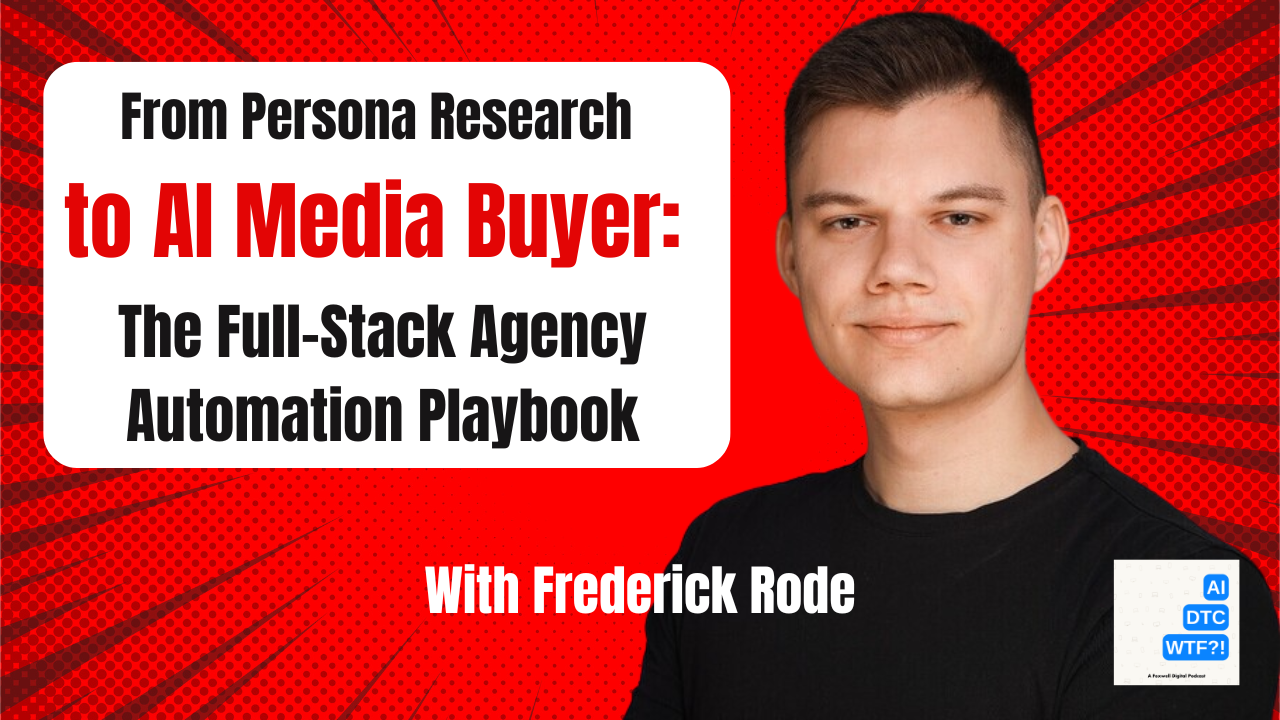
From Persona Research to AI Media Buyer: The Full-Stack Agency Automation Playbook
Frederick Rode, a German AI consultant transitioning from creative strategy to full-scale agency AI implementation, joins Andrew and Thomas for a detailed breakdown of the systems he's actually running.
The episode opens with his Claude research agent, a no-code Claude skill wired to Foreplay (for competitor ad library scraping) and Firecrawl (for web scraping) that outputs a 10-page brand document for agency teams to review first thing when they arrive to the office. From there the conversation covers automated ad performance reporting, and the "easier version" of that same pipeline that listners can implement right away. Thomas then shares that he currently has six Mac Minis running AI media buying for 10 of his clients (still monitored by a team but working). Freddie rounds out the episode by walking through a multi-agent CRO landing page system he built in one afternoon with Claude Code, and why splitting one big agent into three specialized ones (copy, layout, CRO) produces dramatically better output. The episode closes with a candid conversation about AI adoption: agencies are excited, not scared, and the ones moving fastest are freeing employees from execution work so they can focus on analysis and strategy.
Key Takeaways:
How connecting to Foreplay's MCP server via Claude is changing the way brands can analyze their competitors' ads
Why Freddie skips local file storage and auto-upload all research directly to Supabase.
The "easy version" of automated ad performance reporting, and how listeners can build this without needing direct Meta API access.
How Railway is turning a weekly Slack performance report into a $5/month automated system for agencies
The ClickUp status trigger that automatically checks ad creative for grammar errors before they ever go live
How to build a multi-agent CRO landing page system in an afternoon with Claude Code, and why three specialized agents outperform a single all-in-one agent every time
Products & Software Mentioned
Claude (Anthropic) — https://claude.ai (core model; used for skills, research agent, all downstream workflows)
Claude Code — https://claude.ai/code (used to build CRO landing page agent and grammar review automation)
Foreplay — https://foreplay.co (save and scrape Facebook ad library; one-click MCP server connection to Claude; competitor ad transcripts, video downloads, run duration)
Firecrawl — https://www.firecrawl.dev (web scraping via MCP; extracts brand pages, Trustpilot reviews, competitor sites)
Gemini (Google) — https://gemini.google.com (visual analysis of competitor ad videos via MCP; analyzes hooks, angles, text overlay, first 3 seconds)
Supabase — https://supabase.com (database for storing personas, ad performance data, copies, headlines; official Claude MCP integration)
Meta API — https://developers.facebook.com/docs/marketing-apis/ (official ad account data: spend, hook rate, ad-level performance)
Apify — https://apify.com (ad scraping tool with official Meta ad scraper; receives post links from 2-Minute Reports and downloads asset URLs, videos, images)
2-Minute Reports — https://www.2minutereports.com (Google Sheets-based ad reporting, similar to Supermetrics; scheduled auto-reports; no Meta API setup required)
Frame.io (Frame) — https://frame.io (creative review platform; API used to automate grammar/copy QC on ads the moment they hit "ready for review" in ClickUp)
ClickUp — https://clickup.com (project management; task status change to "ready for review" triggers Frame API automation)
Railway — https://railway.app (~$5/month; connects GitHub + runs scheduled script to deliver Slack performance reports automatically each week)
North Beam — https://www.northbeam.io (MTA attribution tool; discussed as a potential data cross-reference source alongside Meta reporting; has an API)
Motion / Runneth — https://motionapp.com (sponsor; AI agent inside Motion's creative analytics platform, powered by Claude, trained on $14B in ad spend)
Codex (OpenAI) — https://platform.openai.com/codex (coding AI; mentioned as an alternative Freddie is exploring alongside Claude)
To connect with Freddy DM him here https://x.com/freddyrode3
To connect with Andrew Foxwell reach him here Andrew@FoxwellDigital.com
To connect with Will Sartorious DM him here https://x.com/will_sartorius
To Connect mith Thomas Moen DM him here https://x.com/thomasmoen
To learn more about Foxwell Founders and conversations like this one, go here: www.foxwellfounders.com
Full Transcript
(00:04) If you work in D2C and you use AI and you're wondering what the F is going on every week, this is your podcast, the AI D2C WTF podcast, your home for tactical tips, strategies, and ideas that you can implement right now in your AI workflows to make your brand or agency more money. Hey, welcome to another episode of AI D2C WTF.
(00:28) So glad to have you here. This podcast is all about ensuring you have tactical advice to take away and utilize in your e-commerce agency or brand right away. That's really what we're doing here at the AI D2C podcast. So I'm excited to have you, Freddie. For those of you that don't know Freddie, he is a German badass on AI, somebody that I respect and who is absolutely always building incredible things.
(00:53) Freddie, thank you and welcome to the show. Thank you so much for having me, Andrew. I'm glad to be here. So what have you been up to lately? I mean, I know that you're doing a lot of creative strategy. So have you been building tools on creative strategy or what kind of stuff have you been building that's with AI that's been making your life a lot easier? Yes, doing lots of creative strategy, kind of transitioning away from that and just building more with AI, helping other agencies implement AI.
(01:18) And, you know, there are so many, you know, important use cases or useful use cases, especially nowadays with the models getting better, Claude being there. And the first thing that comes to my mind is just like, probably research agent, you know, research skill that sits in Claude. And it just, you know, does persona research.
(01:36) It looks up words, it looks up reviews, and it basically builds this whole, you know, persona sheet that, you know, other skills that I'm using, such as like a script writer or whatever can kind of access. And then the outputs of the stuff that I'm getting from AI are way more, you know, tailored to the brands that I'm working with.
(01:53) So this is, so you have, so talk us through how you're doing this on the research agent. So this thing, like, give me the tactical rundown. So this thing, you've built it how, it sits in Claude. And what is, how did you, like, how are you telling it to go find things? What kind of stuff is it, you know, doing tactically? Yes.
(02:11) So it's a, it's basically a Claude skill. So, you know, it's super easy to create. You don't need any like coding experience or whatsoever, really. And it's connected to foreplay. Foreplay has basically an MCP server, which you can connect essentially in one click to Claude. Then it can use, you know, foreplay for you, basically. It's also connected to another kind of program that is called Firecrawl.
(02:31) And Firecrawl also has an MCP server, but you can also connect in one click. So everything is pretty straightforward. And, you know, firecrawl can essentially scrape websites for you. So this, you know, research agent is, you know, connected to Firecrawl, connected to foreplay, and then has instructions for me, you know, and stuff that I want.
(02:52) So for example, you know, words that the brand uses, you know, and it extracts reviews from, for example, Trustpilot or the brand's website. And, you know, it scans competitors, you know, looks at competitors ads using foreplay. And then at the end comes up with different personas. And I basically give a thumbs up or thumbs down, you know, whether I like the persona or not.
(03:13) And then it gets added to kind of my database of personas for this brand. And then from there on, I can reference it in other skills that I'm running, essentially. Cool. Just jumping in here, Andrew, I think this is super interesting and super cool. So I'm not so familiar with the foreplay. I played around in Firecrawl, which is just amazing to just get a lot of data out pretty quickly.
(03:33) But can you explain a bit more what foreplay is? Yes, foreplay is basically just a tool that allows, you know, you to kind of save Facebook ads from the ads library, right? But the great thing about it is that they have an API or, you know, an MCP server that you can connect to. So you can automatically crawl your competitors, you know, ads library, for example, you get the transcripts of the videos easily, you can download the videos.
(03:55) And then, for example, you know, downloading the videos, you can throw these videos into Gemini, which, you know, you can also connect with an MCP. And then you can basically visually analyze the videos, for example, what's going on in the hooks, you know, what's going on in the first three seconds, what kind of angles are they using? What kind of visuals maybe are they using? And what kind of text overlay? So, you know, this gets super, you know, super helpful.
(04:15) And for you kind of analyzing competitors. Okay, wow. So basically, where Firecrawl goes and looks at websites and gives you the information, foreplay is a way where you can basically scrape ads libraries and give you that data in a structured way so you can work from there. Yes, exactly.
(04:34) You can see how long ads have been running, etc., you know, which is not always a telltale sign for, you know, whether something is a winner. But especially, you know, if it's a video, it's been running for quite some time. And maybe the ad is running like the same kind of concept over and over again, you know, I'm pretty sure that this is a winning concept.
(04:49) And now I can have it analyzed using the API inside of my cloud, and then kind of can, you know, identify winning patterns this way. So there, so you're going through running this research agent, it's doing tons of stuff for you. It's looking at these tools, what other? I mean, one, one thing I've always wondered about the research tool, looking at Reddit is that can it get into Reddit threads, like logging in and that kind of thing? Because sometimes the stuff that's publicly available is not as good.
(05:17) And does it actually like, what's the output of it? Does it come out with different angles you can pursue? Like, is it a written document? Like how, what's the output you have it going into? Or is it actually just going into creating the ads? Yeah. So there's also basically for Reddit, there's like a separate, basically MCCP server that you would connect to.
(05:35) And in terms of output that I'm getting, and maybe I can like link this in the show notes or whatever, but it's basically like a 10 page document, which may sound overkill at first, but especially with context windows being so large, nowadays for these larger models, especially, you know, 1 million context windows for Opus, it can, you know, get a lot of context and it can kind of remember all of the concept.
(05:54) So basically the outcome is like a brand overview, like, you know, the product mechanics, the any like studies associated with it, what kind of is the overarching brand voice? And then like a market analysis, you know, how is the market sophistication level? How are competitors and stuff like this? Then again, it looks at reviews, it extracts those, then like it basically saves full-end reviews in like another document.
(06:16) Then based from those review, it like kind of like creates a like language bank, which is essentially just like words that the brand is or that, you know, at least reviews are mentioning over and over again. So you can kind of try to identify patterns from that. Then it looks again, it looks at competitors. Automatically it finds those and kind of sees what kind of ads, you know, they have running using foreplay again.
(06:35) And then based on all of that information, it creates, you know, persona documents, which feature like the angles, the, you know, benefits for that specific angle that you can use and stuff like this essentially. And, and are these then stored as just MD files locally? Or do you have like your own database of things where you're organizing? Or how are you kind of organizing the data? Because one thing is to have these amazing skills do all the crawling, but kind of how do you make sure you don't lose any data on the way? And then can you
(07:06) kind of take a look at the big picture? Yep. So I think like the first step, you know, when you start using this, probably just save them locally, right? And then whenever you basically open up a new chat, you know, what I would do is like create a project and cloud for your brand. And then whenever you start in your chat, just insert them manually.
(07:23) And over time, that obviously gets tedious. So I think the next step from there is basically taking it to Superbase, which is kind of like a, like database, it also has an integration, an official integration, even with Cloud. So you can just connect it to Cloud, tell it like, hey, I want to create a new database based on this, or like you can even connect the skill to Superbase.
(07:40) So the way that I've set it up is like any kind of research doesn't even get saved for me locally, it automatically gets uploaded to Superbase. And because the skill has those instructions, like, hey, here's the Superbase server I want you to use, upload all of that information, etc. Okay, so you have that.
(07:55) So you're talking about doing all this other consulting with agencies. And obviously, Persona, unlocking Persona is a massive thing that people are getting into. What are other things that you've been building or that you're helping agencies instill that are like blowing their minds? Because this is a big one. If you can go to the client and say, hey, look, I've got a whole bunch of new Persona research, that's awesome.
(08:13) But what else are you building or messing around with that people have really been loving? Yeah, a lot of stuff. I think that first thing is probably like automatic select reports, right? So I'm building this for one agency who, you know, they want their strategist to basically kick off, you know, the day with, you know, some automatic reporting of like, hey, this is how, you know, the ad account is going.
(08:34) And these type of scripts are working well, you know, here, maybe some ideas for videos that you can do some iteration ideas. And so this one is then connected to the official like meta API. So it can basically, you know, download or it gets all of the information from the ad account, such as like amount spent, hook rate, etc.
(08:50) Right. And then saves all of this information in Superbase as well. So this way basically build like a whole like interconnected system, right? You save your like Persona's in there, you save, you know, your well performing ads in there, you save the ad copies, the headlines and all of that data that is associated with this ad account in there.
(09:08) And then each, you know, morning they wake up to like a new report of like, hey, this ad is trending, this ad was maybe a recent launch, it's getting a bunch of spend pretty fast. Or, you know, this ad is, you know, 30% below our CPA threshold, it's performing super well. Here's some some patterns that we've identified, let's try angle X, Y, Z or forever, let's do more ads for, you know, with the split screen hook, that seems to be performing well, like in that direction.
(09:29) And so this is based on the on what Meta is saying, though, right? That's the downside of it is it's based on their reporting. So it's like, it's not a third party or anything. But could you like cross reference it against, you know, North Beam or something like that? If the client wanted to? I think there is, I haven't played around with North Beam, actually, but I think there's a North Beam API.
(09:52) So you can definitely like play around with it. I know also that, and I've tested this, that Motion is coming out with like an API and an MCP server. And so you can connect with that as well. And Motion is obviously also connected with North Beam and North Beam. So yeah, I think that's basically not going to help in the long run.
(10:10) For now, it's, it's basically just, you know, quote unquote Meta. And I saw, you know, it's definitely still more actionable than just looking at foreplay and like maybe even scraping your own ad library. Okay. And sorry, one more question. How do you like tactically do this? Like, what are you using? I mean, I have, I know I have a general idea, but like, what are people wanting to set this up? How do, how are they, you know, setting it up? Ooh, setting this up.
(10:34) So for this, for I think an easy version, a super easy version is getting two minute reports, which is just kind of like Supermetrics was back in the day. It's just you create a report to get the data in Google Sheets. And you don't even need, you know, to connect to any Meta API or whatever. It's super straightforward. And then you use APFi, which is kind of like a scraping website.
(11:00) And they haven't, they have a kind of official Meta ad scraper as well. And then you get the post links from two minute reports, just give them to APFi. It's basically scrapes the, it scrapes the like URL of the asset. So you can like download the video, you can download the image, and then just give that to Gemini.
(11:23) And then you can basically add that data. Like you get the, all of the information that you need, like it's plus the like downloadable files. And you can just add that to Superbase. So you don't need any like Meta API. You don't need to custom code anything really. Just pre-stress for about two minute reports, you know, set up the reports that you're looking at anyway, like maybe high level account overview.
(11:42) And then also you look at like daily, daily ad spend or whatever. And then you can just add that to Superbase. But do you then run like a scheduled roaming cloud co-work or how do you actually trigger these reports? Yeah. So for these reports, so two minute reports, you can schedule. So that runs automatically, you know, any, you know, every day, every week, however often you want to run.
(12:05) And then for getting the data into Superbase, there's another service that I'm using. It's basically called, it's called Railway. So what you can do on there, you can connect like your GitHub and then also basically set up a schedule. So it also runs every single week. And then it, that's for like the Slack automation to get the report into Slack.
(12:27) Costs like $5 a month. So it's basically free. And then it runs every week and basically creates that Slack report essentially. Okay, cool. What I think is really interesting when I talk to different people like you, Freddie, is that what we're learning now is kind of the processes and what's useful and what's not useful.
(12:50) And I feel like the tools are constantly changing, but we're realizing kind of what is, what do we need help with and what we need to get done. And of course, the models will be better, the MCPs will get better. But what I think is really cool is that it's getting like week by week, it's getting more and more useful and we kind of nail down what we want.
(13:12) And we can just like switch out small little tools along the way to make sure that just the output and the results are just getting better and better as the technology evolves. Yes, 100%. I think at the beginning or maybe last year, like lots of stuff was maybe a little bit unnecessary. I think now it's actually turning into like, you know, which workflows are maybe like, you know, taking up too much time or which can be automated and then using AR to automate, you know, those workflows.
(13:37) And one example that I have is also like as a creative strategist, you know, reviewing ads, there was a big, big, you know, chunk of the job, I guess, you know, and one part of that is just like checking for grammar issues on the ads, you know, maybe some of the transcripts, they have like grammar issues or maybe on the ads, maybe like a word is spelled in the wrong way or whatever.
(13:58) And if you're using, you know, certain, maybe Google Drive, for example, you know, you know, as long as they have an API, I'm using frame for this, is that you can basically automate that kind of review part, right? So I'm setting up an automation right now that is, you know, the brand is using ClickUp as soon as it gets turned into, you know, ready for review or whatever.
(14:20) And we have the frame link linked in the ClickUp task. And as soon as something turns to ready for review, it goes into frame, basically using the official API, looks at the image and or video and kind of checks is there if they're like any grammar issues. Now, it sounds like such a small like issue.
(14:38) But in the end, that is like, you know, saving me at least speaking from my own perspective, like a whole lot of time, if I don't, manually have to like check the transcript or, you know, look at a whole two minute long video to see if there's like any grammar issues going on in that video. That's great.
(14:53) I mean, so one thing I'll just jump in on a question, Freddie. So I think a lot of people are thinking about sort of an AI media buyer. And I'm curious if you think this is close. I mean, I know Thomas has done this and Thomas can tell you briefly about his process. But, you know, so the AI media buyer would go ahead and look at optimization ideas and correlation between like in platform, MTA, MMM, and then it would be like approved by a person.
(15:20) So if you have you set this up for people? And if so, like how outside of what you just talked about in terms of like automated reporting, what other things would you set up to make sure? And how what tools would you use to because I think a lot of people are thinking about this. It's like, bring me the ideas and then let me say yes or no.
(15:42) AI D2C WTF is brought to you by Motion. And this episode is brought to you by Runneth from Motion. And if you run paid social, I mean, obviously, you know, Motion, it's a creative analytics platform that everybody uses. But the thing I've been obsessed with lately is Runneth. And it's their AI agent that lives right inside of your ad data.
(16:02) The simplest way to explain it, most people use AI by asking it one thing, like, hey, what did we do yesterday? How'd it go? Runneth is the upgrade of that. You just tag it and ask it to do almost anything. It goes into your account, does it like build me this week's creative recap, pull the data and write a brief on what to iterate next.
(16:17) Tell me which ads to make next. And it goes on and does this in plain English. So two things that actually make it really special, right? So under the hood, it's Claude, right? And anything Claude can do, Runneth can do basically even better as long as you get access. And second, it's wired from everything Motion has.
(16:34) So the AI tags, the creative, the frame by frame breakdowns. And then it's trained by $14 billion in ad spend on Motion's customers, right? So it's pretty insane. So the way that, you know, we're using it, and I know some other colleagues are using it, like I looked at what they're doing, and we talked through it.
(16:51) People are, you know, having it drop a morning brief in Slack on how the account's performing. It gets smarter every time it runs. It's less like a tool and more like a creative strategist working while you sleep. So go see it at motionapp.com. That's Runneth from Motion. And make ads that win without getting lucky. Yeah, I don't actually have set it up yet.
(17:15) But I also saw Zach's tweet, I think, about him, like automatic media buying as well. I don't know if you saw that, Andrew. Zach Stacks. But I think we are like basically almost there. I think a lot of the stuff that helps with this is basically giving the LLM or the AI context, like giving it your own SOPs, like basically, like what you would give your own media buyer, you need to give it to the AI, right? And then maybe not the, maybe the first run isn't the greatest, or maybe not the second, but you give the AI feedback. And then,
(17:42) you know, it gets the memory, it becomes basically a self-learning kind of, you know, agent, essentially. And then maybe in a month or so, you can automate a lot of the media buying. And just because every brand is different, every brand obviously has different like media buying principles and what they act up on, you know, maybe it's CBO, maybe ABO.
(18:00) Just make sure that you give good context to the AI of like how you do stuff. And then, yeah, I'm pretty sure you can automate media, you know, automate media buying to a good chunk. For sure. A hundred percent. And I think, I think this is definitely kind of the next phase of what agencies are going to do.
(18:19) So one thing you're talking about, we've been talking about previously, like doing research or finding typing mistakes and, and, and all that stuff, right? And actually pushing the buttons is, is possible today through most of these different APIs, right? And I think we're going to see big, big, big moves in that space just within a few months.
(18:42) I've been playing around myself with, I have six open machine, Mac meanies on my, in my office around me at this moment. And they're doing media buying now for, for 10 of my, my clients from my agency. And, and it's still a little bit scary, but it actually is working. And we have, of course, our team monitoring and checking in everything.
(19:02) So I think that if me with a little bit of duct tape are able to set something like this up, I think there's going to be a lot of interesting services going around the, around this for sure. Because you're talking to so many different agencies, Freddie, what I would like to get your kind of gut feeling on is how in front of this are agency, DTC agencies today? Are they, are they afraid of this? Are they like surfing the wave? Or are they just waiting kind of what's the general vibe you get out there? Hmm. Yeah, I think they're excited for
(19:40) it. Like some of the stuff that I've seen, like agency owners build is, is super crazy to me. Like they've built some really advanced stuff. And I think everybody's like excited that they can maybe also have their employees do more important work, you know, whereas before maybe they had to, you know, name ads or like even launch ads or like, you know, do media buying, maybe you can do more analysis, or maybe you can do more like high level stuff that's actually moving the needle more than like naming an ad.
(20:04) Um, or, um, stuff like this. I think the agency process is like, is coming down to getting rid of sort of the, the, the noise. And I think a lot, a lot of where, you know, I've seen agencies step in and say like, okay, I've got to figure this out. I got to get better at this is a lot of people spend time, like you said, getting together reports and reporting.
(20:25) And I think it, you know, sort of wrapping all those into a place where a client can take action, I think is the next step. A lot of it is like the analysis is happening. You're giving people these reports on personas. Um, you're putting it, you're putting it in front of them on a platter and the client's like, oh, cool.
(20:42) And like, really the next thing of this is being able to say like, yes, like, you know what I'm saying? I don't know what you think in terms of talking to other agencies. Um, you know, obviously like, I assume these are German agencies or maybe they're not, but they're probably, if they are, they're quite orderly in terms of like getting people the information that they need.
(21:01) How do you see this evolving? Like in terms of other tools people are using and things that they can, um, you know, get on and get learning to make sure that they're ready for, for this. Yeah. Um, so I think like one of the agencies that I'm working with, they basically have their own like custom software, I guess already, right.
(21:22) They have basically kind of like a place for their strategists and where basically, you know, those reports essentially generate ad copies, they generate scripts, um, and stuff like this. And then essentially they approve of the, you know, of those concepts. And if they approve, it goes basically to the client and, um, you know, if the client likes it, they basically produce that type of content.
(21:41) So I think kind of that's like, you know, the evolvement, you obviously, you know, you have the reports and I think that's already pretty helpful, but obviously, you know, next step is like basically generating that meaningful work, which I think for, if we're talking about creative is that, for example, script writing or like finding patterns, for example, and then, you know, they may have like ads manager, like creative strategists, agents, they find those patterns, you know, he has like winning ads and then it goes straight to
(22:05) the, um, creative strategist and they approve of those patterns. They approve of the new hooks and then go straight to the client. Um, so basically kind of, kind of like a mini says, I guess, for those clients of the agency. It's so true. I think it's, it's, it's interesting to me because I think the, each piece of this that is, is getting more automated.
(22:25) So in terms of creation of like, okay, we're building this, you know, the persona builder. And then it's like the next phase of it is now it's like, it's building the persona builder. You have the brand guidelines, it's got it all in there. It's stored in super base. And then now they're able, it's able to like build and potentially publish and start to optimize ads.
(22:42) Um, you know, as, as you train it over time, I think that that's a really valuable one to think about as you kind of go through and learn this stuff, Freddie, like obviously you're deep in it. How are you continuing to upskill yourself? Like, how are you making sure that you're staying on top of it? Um, as much as you possibly can.
(23:01) Yeah. Or is it just messing around? I mean, I get FOMO on the daily about like, there's so much new stuff always coming out. I think, um, basically kind of committing to like one kind of like platform, like, you know, Claude and then also like Codex. Um, for example, I haven't played around that much with OpenClaw yet.
(23:20) Um, and then kind of staying on top and then also just being a lot of, on Twitter. Like there's so much stuff being built on Twitter as well that other people are sharing. Like every day I probably save like 10 bookmarks. And then also just a lot of like, like, Hey, I have this idea, for example, like the creative automation would like automatically reviewing the ads.
(23:36) Like I think that popped in my head yesterday. I'm like, I don't want to review grammar anymore. Just type it into Claude Code. Like here's what I want. Here's what, which software I'm using. Um, can you help me build this? And then 95% of the time it's just, yes, it can help me build this. Um, and then I think the next question is just like, how can I integrate that into my, into my, my workflows? Like how can I make use of this? Not as a standalone workflow, but actually kind of part of my daily routine, I guess. Right.
(24:04) So it's not like one-time build and it's helpful for like 5% of the cases, but like actually helpful on the daily. And the creative stuff that you're built. So you see in terms of Facebook advertising today, creative being obviously the main lever, which I think a lot of us are going on. Do you think that there's going to be a period of time in which like the optimization or the, um, automatic stuff that we're doing with AI is going to be able to, is going to be adjusting bids and things like that? Or do you think that's mostly going to
(24:31) live within, like, it might be a leading edge to do it now, but like mostly meta is going to be doing that itself and you're not going to have to mess with that as much. Like, is it mostly going to be around continued optimize creative? And also on top of that, like, have you done anything messing around with like the other parts of the funnel, like websites or whatever, cause you can do all you can on the meta side, but you know, like obviously the landing pages are massive as well in terms of getting that flow
(24:53) and the match between those personas. Yep. Um, so regarding meta, I mean, I think, you know, you can definitely set up the, I don't know if the API has bit caps actually, if you can change those on the API, but like, I think like, like, like it can, the stuff can be automated for sure. You know, whether it's meta or whether it's like, you know, through an API or through some sort of skill, um, you know, I don't, you know, that's yet, you know, yet to come basically.
(25:18) But I think in terms of landing pages, like definitely, you know, I've played around with this. Um, it's pretty fascinating what you can build. Like I spend like, you know, one afternoon basically built like kind of like a, an, a CRO landing page agent, which basically, you know, generates landing pages, um, for a client. So basically based on the research from the research agent, um, that kind of landing page agent uses that research and the words, the reviews, et cetera, then you could give it like one other landing page that you are having, you know, whether it's a
(25:47) PDP or like an actual landing page. And basically it goes then in there, analyzes that landing page and like iteratively comes up with improvements. Um, you know, you can task it to make like small improvements, kind of like a CRO agency would do it basically. Or you can also kind of completely, you know, restart new landing pages.
(26:04) Um, and those landing pages are so on, like, I was surprised myself, like how on brand they were. Like it was using the exact, like, like even the copy, like it's basically split. So it has like a copy agent, which is basically only responsible for the copy that it kind of, kind of has like a layout agent, which is only responsible for like for the sections for the layouts.
(26:22) Like, you know, how was the hero structure? Um, like how was the kind of buying section structure, et cetera? And it was pretty good. Yeah. You saw the tweet. Yeah. Yeah. Well, so what do you, what tools did you use to build that one? What tools? I just like clock code, basically like typed it in like, Hey, like, uh, I want to build like a landing page agent, um, for this brand.
(26:41) Like here's the research that I've done on that brand. Please make sure you follow those, those, uh, instructions. And then thought of like how, because I think like in terms of like building this, you need to have specialized agents, which are responsible for one specific task. I think, you know, one landing page agent, which does everything probably won't be as good as having like three different agents, but in the same landing page, you know, like a copy agent section, like section building agent, and like a CRO agent, um, which checks for like CRO improvement
(27:06) stuff. So I think like giving one agent a very specific task is like super helpful with this type of stuff, right? Like you have, you don't have one creative strategist agent. You have like one, which is responsible maybe for analyzing the ads. And then another one, which is responsible for like writing the scripts and stuff like this.
(27:22) Just, uh, it's so exciting to just see what's possible and the quality that's just becoming so much better every day. So it's just like, uh, yeah, I'm, I'm, um, I'm both kind of scared and really, really excited at the same time because it's just changing so fast and it's, it's just, um, um, hard to keep yourself updated.
(27:47) So I think that the FOMO you're, uh, you're referring to, Fred, is, is real with everyone. And I think, uh, the more everyone of us can kind of share best practices and also kind of all our fuck ups and that, you know, that, that's what we want is just kind of help each other navigate and understand how to get maximize this to, to help as much as possible with our clients and our businesses.
(28:08) Yeah. Well, uh, Freddie, thank you for coming on. Freddie, Freddie will, uh, we'll do a quick loom overview of some of the things he talked about on this that we'll put in the show notes and, uh, we'll share that along with any links to the other things that he talked about. Um, and if you want to contact Freddie, I can put you in touch with him.
(28:26) You can always email me andrew at foxwelldigital.com and I'm happy to connect. Freddie, you're a rockstar dude. Super appreciate having you on and, uh, we'll talk to you soon. Thank you so much for having me. Thank you, Freddie.
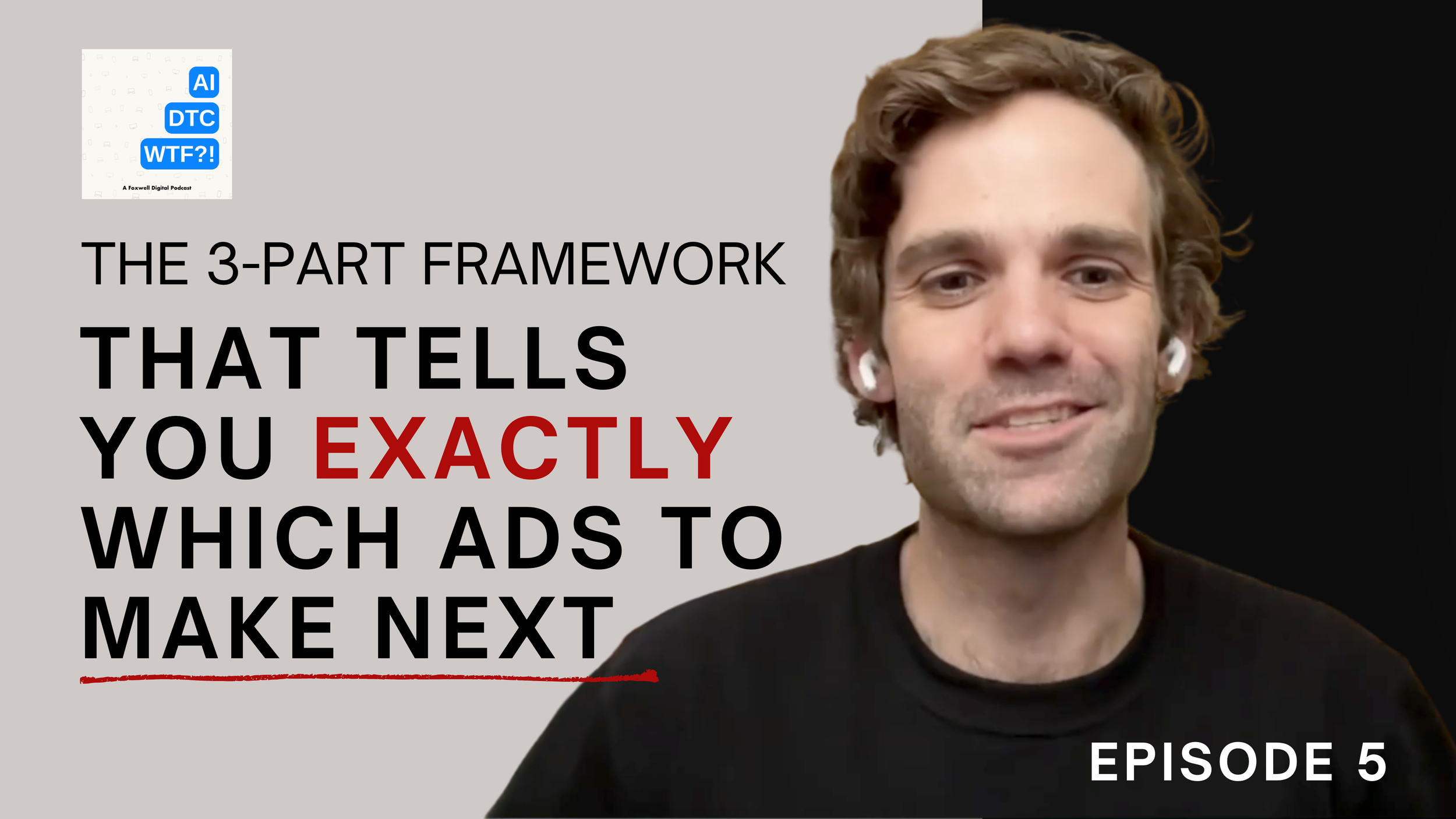
Will Sartorius's The 3-Part Framework That Tells You Exactly Which Ads to Make Next
FCo-host Will Sartorius chats with Andrew on a wide-ranging episode that opens with a hot-take roundup on the latest model drops (Claude Opus 4.8, Google Omni (Veo 3.4)), and why Google Flow's $200/month subscription might be the most slept-on deal in AI right now.
Will then shifts gears and dives into his full operational playbook. He breaks down how his agency uses AI to close more enterprise deals (a proposal workflow that litterally turns a sales call recording into 14 spec ads, a gap analysis, and a competitor breakdown that's delivered same day). He then outlines the three-piece framework his team uses to generate better creative: gap analysis, time series analysis, and social listening.
Andrew and will also get real about the messy details of AI and how tool costs can add-up fast, the danger of automating for automation's sake, and how to actually structure AI governance inside an agency. This episode closes with a four-bucket framework for how agencies and D2C brands should be thinking about AI as they move through 2026 and beyond.
Key Takeaways
The same-day proposal workflow Will is using to close enterprise deals faster and how you can too.
Why the gap analysis the first piece of the creative puzzle and what Will's AI tool actually shows you about your ad account.
What a time series analysis is for ad creative and how you can use the Meta API to tag every ad you've ever run by persona, angle, format, and emotion.
How social listening on these platforms will change the ads you prioritize.
How Google Flow's $200/month subscription actually stacks up vs. paying per-generation on SeaDance for high-volume video work.
Why Will decided to go back to having a human editor QC every AI-generated static before it goes live.
The TRUE cost of "playing around" with AI, and how to audit if your AI projects are actually generating revenue versus just burning tokens.
How the smartest agencies thinking about AI governance and what every agency needs to build out now
Products & Software Mentioned
Claude Opus 4.8 / Claude Sonnet 4.6 (Anthropic) — https://claude.ai (used for copywriting agents, tagging historical ads, and proposal workflows)
Claude Code — https://claude.ai/code (used for proposals, landing pages, and creative workflows)
Google Omni / Veo 3 (Google) — https://deepmind.google/technologies/veo/ (video generation model)
Google Flow — https://flow.google/ ($200/month subscription unlocking Nano Banana, Veo 3.1, Veo 3.2, Omni)
Nano Banana (Google) — Google's image generation model, accessible via Google Flow
C-Dance / Sea Dance (ByteDance) — Video generation model; comparable to Google Omni but priced per generation
GPT-4o Image Generation (OpenAI) — https://openai.com (referred to as "GPT-2" for image/static generation in context)
Read.ai — https://www.read.ai (AI meeting recording and transcription)
Granola — https://www.granola.so (AI meeting notes; mentioned as comparable to Read.ai)
11 Labs (ElevenLabs) — https://elevenlabs.io (voice AI; briefly mentioned)
Meta API — https://developers.facebook.com/docs/marketing-apis/ (used to pull historical ad data)
adlib.getskipper.ai — https://adlib.getskipper.ai (Will's free gap analysis tool — enter your brand, get persona/angle/emotion gaps)
Skipper — Will's product (social listening and creative intelligence platform; referenced throughout)
NFL.ai API — Used for generating static ad images directly into Claude Code workflow
Higgsfield — https://higgsfield.ai (AI video platform; mentioned as an alternative to Google Flow)
file.ai — Referenced as a platform team uses for video and static generation
Vercel — https://vercel.com (used for spinning up landing pages quickly)
GitHub — https://github.com (used in landing page/CRO workflow)
HQ — Project management tool for AI workflows (referenced as a way to organize Claude Code projects)
Codex (OpenAI) — https://platform.openai.com/docs/guides/code (mentioned as an alternative coding AI)
To connect with Andrew Foxwell reach him here Andrew@FoxwellDigital.com
To connect with Will Sartorious DM him here https://x.com/will_sartorius
To Connect mith Thomas Moen DM him here https://x.com/thomasmoen
To learn more about Foxwell Founders and conversations like this one, go here: www.foxwellfounders.com
Full Transcript:
(00:00) If you work in D2C and you use AI and you're wondering what the F is going on every week, this is your podcast. The AI D2C WTF podcast. Your home for tactical tips, strategies, and ideas that you can implement right now in your AI workflows to make your brand or agency more money. Welcome to a new episode of AI D2C WTF.
(00:27) We have Andrew and Will here. Andrew is working at 50% capacity because he's been going to the opera too often and taking stage and singing a little bit too much. Yeah, people don't know this, but I actually smoke a pack and a half a day and it's finally just affected me. You know, I'm also a part-time performing artist.
(00:48) You're a Marlboro Red guy, right? Big Marlboro Red guy. Yeah. And it's finally affected me. And the reality is I have a six-year-old and, you know, she licks my face, you know, or something. You know, it's like kids do gross stuff and that's what happens. So I'm sorry. Maybe some people like this. You know, maybe I'll have to like 11 labs and like keep this on because people are going to like the smokiness of it.
(01:12) You know, some people like a smoky me and some people like a smoky voice. And that's kind of what we're doing here. You're the most interesting man in marketing. Yeah, exactly. Exactly. Yeah, well, we're glad that you're here. Thank you for listening. There's been a lot of interesting new stuff that I would love to go through with you, Will.
(01:33) What's some of the newest stuff that's come out? I mean, there's so much. Claude came out with a new model, BT Dubs. What's your take on it? What can it do that the others can't thus far based on what you're seeing? Yeah. So, yeah, the two big drops this week or I guess over the past week and a half were Google I.O.
(01:53) , of course, which released Omni, which is their new video model. And then obviously Opus 4.8, which came out yesterday. So I can't say I have a clear sense of how much better it is than 4.7. What I can say is it uses a lot of tokens for commensurate tasks and compared to 4.7. So, for example, last night I was generating like 20 static ads for a client.
(02:19) They were just in Wirecutter. So we just wanted to spin up 20 ads with the Wirecutter branding. Just get that out there sort of ASAP Rocky. And I think it used like 850,000 tokens to write copy for 20 ads. Oh, my God. Which is pretty crazy. I will say, though, we have a pretty intricate process where we have 10 copywriting agents and each of the agents have to give the copy a score of 90 or higher or else it doesn't pass.
(02:48) And so historically, I think what was happening is it would just be like, ah, you know what? This is good enough. But I actually think I was on Opus 4.8 max at first and then I went down to extra and I found that actually the copy that it wrote, granted it took three hours, was very good. Like probably the best copy I've seen come out of Claude.
(03:07) And the other thing I found is that if you have a system with a handful of different skills marked on files, Opus 4.7, 4.6, they would skip a lot of steps and sort of say like, oh, you know what? I forgot that step. Let me go back and do it now that you've sort of called me out. What I found is that Opus 4.
(03:28) 8 doesn't necessarily skip as many steps. It's more intricate in reading your instructions, which is very, very helpful. And then on top of that, when you do slash goal, it very much, it feels like when you do slash goal and give it a specific end goal, it feels like it holds itself to a higher standard in the sense that like I need to do all these steps properly and not just like use my sort of human companion to bounce ideas off of.
(03:59) I candidly haven't been in Codex too much. I know everyone is telling me I should be doing more in Codex. I, you know, we use GPT-2 for image and static generation. I'm just like so, you know, embedded in Claude code at this point. And I just like Anthropic as a company more than OpenAI. So that's just like sort of like a morality thing.
(04:25) Maybe they're both sort of evil. But at the end of the day, yeah, I think 4.8 is better overall. I think the reasoning and the token usage are definitely correlated and they're definitely up. But overall, I would say from what I've seen thus far, the copywriting is, as it pertains to marketing, is superior than that of 4.7.
(04:48) Of course, you need to be giving it the right parameters to get good copy. I mean, what about this new Google thing that's out with the video? What do you think about that? Yeah. So Google Omni, this is like sort of Veo 3.4, I guess, technically. I think it's great. I think it's, again, probably on par with C-Dance, which is the ByteDance model.
(05:10) They're very, very similar. What I will say, though, is C-Dance gets pretty expensive pretty fast. If you wanted to do a full claymation Pixar ad, those things are all the rage these days. Or maybe they're gone. Who knows? It probably costs you $20 to $30. What's cool about Google is if you use Google Flow and just pay for a monthly subscription, I think it's like $200.
(05:35) You effectively get unlimited usage of their models. So you're getting $200 and you can use Nano Banana, Veo 3.1, Veo 3.2, up to Omni. And it just feels like that's a no-brainer. And I think that's just like a slept-on thing. People are probably just using Higgs field or file.ai or going directly to the interface.
(05:58) But yeah, Google Flow is great. We just built an account and that's what our team uses when we're generating videos. So now we're saving money because we're not really using C-Dance anymore. We're able to utilize Omni within this channel. I will say, you know, one thing I've noticed is that our file.
(06:15) ai where we're generating videos and static bill has gone way up. It's not necessarily a bad thing because we're generating a lot more statics. And we can sort of get into that in another episode. But ultimately, yeah, the Omni model is great. It's super solid, I would say. Probably on par, if not the best video model right now.
(06:36) Like if you want to animate statics, it's ridiculously easy. Also, product fidelity, it does a really good job with. Generate the ad first in GPT-2 as an image. Use that as a reference. And then upload that to Omni. And you can get a pretty good video. The other thing that's sort of like top of mind right now is, was it June 9th? In New York, you're going to have to start disclosing if you're using AI creators.
(07:03) So that's just like something to be on folks' radar. You'll need a disclosure there. One thing, you know, I was on a sales call earlier and they were saying they're nervous. This is a, you know, a larger brand. And they're very nervous even about using like hands or feet for AI. So, you know, I did some deep dive in there.
(07:19) And I know, Andrew, you are, you know, you probably have more experience with law than me. But it seems like there's a lot of gray area in this thing where there isn't a lot of explicit language about certain use cases. So it's hard to say for sure, like what is going to consist of this sort of AI generated content.
(07:39) Like if you have an AI persona talking and applauding a product like that is going to be problematic. But if you're just showing a hand, like I can't see that necessarily being an issue. But invariably someone's going to get sued or I guess, and we'll have to sort of figure that out as we go. But yeah, June 9th, it's approaching quickly.
(07:57) Something just behind folks' radar. Good shout. The legality thing, I mean, we'll continue to see this, you know, change and evolve over time. I think there's a couple of things you never want to under, sorry, you never want to overestimate, which is the competency of Congress to actually legislate something, which they won't.
(08:15) And you also never want to underestimate the power of what lobbying can do, of which there will be an anthropic and others. It'll be, it'll go the way of meta and, you know, social networks. It's not going to be really legislated a lot. So I wouldn't necessarily think about it too much, but state law will become where the issues are.
(08:38) So you just have to kind of be aware of that, be ready for that. Any other major releases we want to talk about, Will? I think that is sort of the gist of it. All right, cool. Well, good wrap up and let's go ahead and get into the episode. Today, we're really talking about, Will, what you're doing with AI. I think the people know about you.
(09:00) They know that you do with AI creative, but, but like, let's get into the high level and then let's go really specific about what you think is the future of this and all that. But first of all, so like, what are you, what are you doing with AI right now in your company? Yeah, I would say AI. To sell. To sell. Okay.
(09:17) Yeah. To sell. Sure. To sell first, let's frame it up. Yeah. Okay. So great question. AI has made making sales proposals so much better. So when I get off of a sales call, what I've created is effectively a markdown file. So, you know, we use read.ai. It's the same thing as Granola, you know, AI recording. So what I do is after a sales call, I take the recording from the sales call.
(09:43) I upload that into a cloud folder that I attach to cloud code. And then I have a workflow in which it reviews the call. Then it goes to the brand's website, scripts products, scripts product descriptions, and, you know, fonts, colors, et cetera. It'll generate 14 spec ads sort of based on what we talked about in the call.
(10:06) Additionally, what it does is like does a bit of a very quick gap analysis, like what are your competitors are doing that you're not. And that way, like I have one candidly going on in the background right now from a sales call that we went on this morning. The full process probably takes five to seven hours, like doing sort of end to end.
(10:24) But what ends up happening is I get this beautiful looking proposal with 14 spec ads ready to go that I can deliver to them same day that has like everything that we discussed in the call embedded within the proposal. Insane. It's insane. So good. It's insane. And like we are now, I genuinely believe this, you know, just based on the way our proposals look, and I'm happy to sort of share this with, you know, believe this in the notes or whatever.
(10:52) Like I genuinely believe just based on how our proposals look, like we are closing enterprise deals at a higher clip because it just feels like this is, these people really care about polish. And yeah. And the other cool thing about this system is if you have the brand send over like brand guidelines, et cetera, you ingest that into your cloud code as well.
(11:15) And so like it's you effectively are creating an agent to QC against brand guidelines. So when you deliver those assets for a brand that really cares, everything's pixel perfect, you're going to sort of hit the mark right off the bat. I mean, it's so it's so great. Like it's it's such an easy thing to do. But what I was really asking was like, you guys make ads for people utilizing AI, right? But you also wrap in customer personas.
(11:39) And like, that's the that's a big, deep part of what you do, right? Yeah, of course, the ad creation is like, it's the last piece of the puzzle, right? Like, I think I talk about this on most of my sales calls. So and we may have talked about this in the podcast before, so I'll keep it brief. But I think there's like sort of three pieces of the puzzle to generate great ads.
(12:00) You know, the first piece of the puzzle is a gap analysis. You know, I've built a free tool adlib.skipper.ai, adlib.getskipper.ai, where you can put in your brand, it will show you like, these are the personas, formats, angles and emotions that you're not focused on that you should be focusing on. And I'll give you 10 recommendations on ads to build.
(12:18) That's sort of piece one. So it's like, you are focusing on these personas. And like, especially for folks that are struggling with CAC. And it's like, you know, we can't get new customers or CAC keeps flying. But the issue is you probably keep targeting the same people again and again. So you've trained your pixel to just like look for the same type of person, right? Like you need to be training people.
(12:38) You need to be training Meta's pixel to be looking for new audiences. So sort of the gap analysis is one. And I'll add to that in a moment. The second piece of the puzzle is time series analysis. I think the antiquated way of thinking about things is, oh, you know, we had that great ad in January. Like, why didn't we ever do anything more like that? Why didn't we ever hit up that creator again? Or like, oh, we had that, you know, static that did really well.
(13:04) Like, why did we turn that off? Like, this is how agencies and brands talk. And it's just like, it feels like the stone ages. Because like what you can do at this point is using the Meta API, I would say use the Meta API. Don't use MCP. The MCP sort of breaks. Even the Meta API sort of sucks, but it's better than the MCP.
(13:22) What you can do is you can pull all of your ads that you've ever run. You can use Cloud Sonnet 4.6. And you can tag every ad you've ever created with persona, angle, format, emotion, and ad type. And then you can correlate that to performance. And so you can say like, okay, for the past five years, like these combinations have been my winning formulas.
(13:43) And like, here are the ads to back that up. So if you're creating a system where you are never losing learnings, like every learning is compounding on one another. And that's like also why like creative velocity is so important, right? Like the more ads you're putting into the system. And like, I know this is like a controversial take.
(14:01) I'm of the opinion, like for every $1,000 you're spending, you need to be testing a net new creative. And I don't mean an iteration. I don't mean a new hook. I mean like a net new creative, right? Even if it doesn't get enough spin, you'll still get signals that will go into that time series analysis that will tell you, you know, this persona, angle, emotion had a great CTR.
(14:18) So like maybe there's a CRO optimization you can do. So anyway, so we have the gap analysis, the time series analysis, and then the third piece of the puzzle, and this is what we're building with Skipper, is social listening. You know, looking at what folks are saying in your reviews, what folks are saying on Reddit, on Trustpilot, on Quora, on Amazon, and saying, okay, these are like my core eight to 12 personas.
(14:38) This is what they care about the most with a product. Like these are the angles that they care about the most. And then what you do is with the social listening, the time series, the gap analysis, you put that together and you have this really nice Venn diagram of like, here's what the gap analysis is telling me to do.
(14:57) Here's what my time series analysis is telling me to do. Here's what people talking about my brand are telling me to do. Where's the overlap? Okay, great. Here's the overlap. Here are the ads we should be creating. And so like, when we now have an AI, we call it AI creative only team, but there are eight people on it, right? Like the whole idea is like, there's humans in the loop every step of the way.
(15:17) Like we are not at the point, and I cannot reiterate this enough because I get this question almost every day. We are not at the point yet where you can get 10 out of 10 perfect ads using AI alone. You may get really good ones. Maybe nine out of 10 are really, really good. But maybe a few won't have the safe zone or whatever it is, right? So when we have the center of that Venn diagram, right? We can give that to a creative strategist.
(15:43) The model will say, hey, you know, this is what I'd recommend putting together based on those three things outlined. And the creative strategist will say, great, give me 20 ads, 20 pieces of copy. It'll spit out the copy. Creative strategist will review the copy. Great. If they like it, great. If not, you know, not so good.
(16:02) Again, like I said, 4.7, we were rewriting a lot of the copy. I just did this wire cutter ads for this client today. And the copy is really good. And so I think Opus 4.8 really, you know, helped out with that. Granted it took like three, four hours. And then the ads are generated. We're just using an NFL.ai API.
(16:23) So it lands directly in our Cloud Code folder. Of course, you can use Higgs field as well. And then I think where I was being really too stubborn for too long was I was saying like, we don't need to necessarily have an editor touch these up. But as we have been now selling this workflow to enterprise, that's just like not, you know, you sort of need to have that.
(16:46) So we... Looking at it, yeah. Yeah. So we have, you know, three people in the U.S. that are generating statics with AI. And then they go to our editing team. We have a 24-hour SLA. And what the editing team effectively is, they're just like brand guideline Nazis. They're just ensuring that, you know, the fonts are perfect.
(17:09) The colors are perfect. The product looks right. Everything's in the safe zone. And that's their job. So, all right, it's just like a QC team. Because when we're at the scale now that we're generating so many creatives, it's hard to be like, is that, you know, is that going to get cut off by Meta's UI? Like we just like needed a dedicated team to do that.
(17:27) And AI will get you very, very close. I would say of all the AI statics we're creating, 90... We're getting to 90 to 95% of the way there. It's just like those like sort of final touches, right? And especially for the brands that really care about pixel perfection. Like if the logo's size is like two pixels off, they're going to be like, that's wrong.
(17:51) So that's where having an editor come into play really makes a big difference at the end game. Yeah. So this is how you've built what you're doing and selling now. And hopefully those of you that are listening can take pieces of that and maybe even think about it in your own agency. So like, how are you as a creative agency utilizing AI within your creative systems? And also like, what is your creative system? Because honestly, you talked through some of it, right? You're going through the process of that's for each client.
(18:29) But how are you utilizing AI in the business to make more money or have more time or, you know, be really like be making great stuff for these folks? Yeah. Again, it's a good question. Some part of me, I feel like since, I don't know what we're calling it. We call it the industrial revolution. Are we calling this AI revolution? I don't know.
(18:51) Some part of it, I think I'm working more hours than I ever have in my life right now, I would say. And I think from folks that are sort of doing similar things, like I have one client that is, he says he works 18 hours a day in Cloud Code. He's just like addicted to it, right? And there is, I feel like a bit of a paradox where you feel like you're putting in more work, but you're getting less out of it.
(19:13) So you really need to sort of figure out which swim lanes make sense. I would say the biggest ROI I've found, one, the proposal game has never been better. Two, CRO. We never did landing pages. You know, we never did landing pages. Landing pages took us like three, four weeks. They were such a pain in the ass to put together.
(19:34) If you had edits, like it would take a designer, you know, four or five days to get edits back. Like now with like Vercel, Cloud Code, GitHub, like spinning up landing pages has never been easier. So in our workflow, like again, if we see an angle pop off for a specific brand, we just spin up a landing page within the next 24 to 48 hours and start driving traffic to that instead.
(19:56) Right? Like it's work, but like the more one-to-one you can go from ads to landing pages, obviously the better. We've talked about this ad nauseum on the Cody podcast. And I don't want to, you know, beat a dead horse here. Like from an operational perspective, I would say at first I was like, we probably don't need to have a project manager anymore.
(20:13) I was wrong. I think having a project manager is actually exceedingly helpful. I like definitely had a bit of whiplash where I was like, I can just sort of automate everything. And I think everyone sort of goes through that period. And then you sort of come back to reality and you realize like the solution is somewhere in the middle.
(20:29) So it's AI plus humans in the loop, which I've always been a proponent of. And especially with generating ads, I will say like from an ad perspective and like an analytics perspective, that is undoubtedly changed forever until token prices like increase astronomically. But like the ability to be able to track how certain personas or how certain angles are performing over time is crazy.
(20:56) It's so cool. Like we just have a graph where I can just like pull up a client. It's like, you know, how is, you know, a mom of 24 to 35, how has she been performing, you know, recently? Maybe she like is an urban mom, right? Like how has that been performing, right? So effectively, we've created a system where when our creative strategists come sign on for the day to start making their ads, they already have a swim lane.
(21:20) They know like I need to be generating ads for this persona, this angle, this emotion. The question is just like, what's the best copy for it and what's the best format to do that in? The AI can guide you, but, and I've said this to my team, again, at Nage, I'm like, the differentiator is taste. Like humans have really good taste.
(21:38) AI doesn't have any taste. There's something soulless about a lot of AI ads that I found. And that's why having people in the loop throughout the process is essential. I think it's, you know, one is I think from the workflow standpoint, and some of you listening to this may really identify with it, which is I think you were doing a certain amount of work because I feel like I'm working more as well.
(21:59) And then you sort of see what's possible. And then you were able to take on these things that you never thought you'd be able to tackle, right? Like, I mean, and that can mean anything. It can mean your creative system based on hooks like you're talking about. It can be creative cohort analysis. It can be, you know, what ads have driven the most net new customers.
(22:19) It could be, I mean, it can be any of that. And the volume of work, you know, I feel like I'm doing the volume of work of like three people now because I'm able to do all this stuff that just was unaccessible before. It just was like, this would take me forever to go through this. And now it's like, boom, boom, boom.
(22:36) We got to do this, got to do this, got to do this. You know, like I built like four landing pages for our own shit like last week. And now I've got to tell people about it. I got to promote about it. And then I'm using AI to write, you know, this and that. So, you know, I think it's big. And we're actually working on a statement about AI now in our organization about like, here's what we believe.
(22:58) Like we need to be transparent. AI augments our work, you know, et cetera, et cetera. It needs to be transparent when we're using it. Because I think we're all sort of in this like rush, gold rush moment. But it's also, we're going to need to come up with some standards in the industry of what it really means, the changes.
(23:13) I think from a creative strategy, or sorry, from a creative systems standpoint, you know, the fact that you're able to do deep analysis is massive. And if you are an organization that's making creative, you know, I think one of the biggest things that you want to always be looking at is not thinking about volume.
(23:32) It's not just about making a bunch of ads. And I think we know this. But it's about making enough of the right ads. And then figuring out what our expectation is as it relates to testing those. And it's also not every ad that you have in your, in the community, like in the ad account, right? It can't be all AI.
(23:52) It can't be all founder videos. It can't, you know, you know that to be successful, we need a mix. And this is what that creative like sort of analysis and systems can be built. I think that what this is allowing, or like can do for us, I think that what it's allowing us to do is build better ads over time and build better like way to categorize and understand where opportunities lie.
(24:20) And it can help you scale faster. If, you know, and that's, and I do think that to your point, a person running project management or CLO type of thing or type of role is absolutely the most critical as it relates to this right now. Because what I see in organizations and that the places that I'm coaching and stuff is like, people are doing this stuff, which is cool, but it's all running around like with their heads cut off.
(24:45) And, and you can have a tool like HQ, which is cool and puts all these projects together and you can see what they built or what you built and you can utilize those projects together, etc. But that is not going to solve for the why in each of this, right? Or in all this, like it's not going to solve for like, what's the incremental progress that we are making? And, and also the incremental revenue that we are making.
(25:12) Yes. And so I think you like, it has to be looked through that lens. And I understand that there's an excitement and like all this, but right now it's very much a noise perspective, you know? And it's not necessarily like moving the needle as much as it possibly could. I was talking to somebody the other day and I said, it's sort of akin to like, I mean, a little microcosm of like when like online messaging became available in the works.
(25:37) Like, you know, like you could tell this person you're going to be five minutes late or like, you know, all these little things. But then it like brought it to a whole different place. And then you're like, wait, where was that? They told me this over here. And so it's like, you have to make sure that you are understanding what the true incremental impact is in the business.
(25:56) And like over the incremental impact that you want to make and that all of these things are aligning towards that goal. And like, that's what we're trying to do. And also, I mean, we're at the point of it too, where having free thought is useful and messing around with it is useful. And that's good too. And some of that can be, we want to be a leader in AI as it relates to our agency.
(26:16) And by doing that, or in order to achieve that goal, we have to just be messing around a whole bunch. Right? Like, how do you enable your employees to sort of think through that will? Like, are you like, look, we want to be putting out 20 new proposals, net new. How are we achieving that? And also, are you taking like every employee takes an hour and a half every day to fuck around? Like, how do you sort of think about this? Yeah, it's a really tough one.
(26:41) And it's a hard solve because I think anyone that's doing this will immediately say like, well, I can just do it myself. Like, it'll be much faster. Like, I've built these systems around myself. Like, I know how my brain works. And that's where I was for a while. Like, I was the one, you know, generating all of the static ads for our clients for a bit because like, I'm neurotic and I can be a bit of a control freak when it comes to our standards.
(27:08) And then I just like found someone that I was able to sort of just like download all of my brain onto. And then she just like took that and like sort of going in her own way. And so like now what I've started to do, and, you know, we just brought in another person to sort of help generate statics as well. Is I sort of say like, hey, here's my framework of how I go about generating ads.
(27:31) This is just like one example, you know, ads as an example. Here's like the step-by-step process. Like, here are all the markdown files I utilize. We're going to send you a website that sort of goes through our whole process. But like, I don't want you to follow this exactly. I need people at the end of the day that are going to, this is like the most cliche line in the world, but sort of like think outside the box, color outside the lines, right? I think I read something the other day, like, I can't remember who it was.
(27:57) Maybe it was like Marc Andreessen was to like people that are going to be most successful in AI are just the people that are just like super unorganized and just like want to be testing a lot of different things, right? Like, and they're just like Renaissance people, right? Jack of all trades, maybe even a master of none.
(28:12) And so like, I think giving people, leading the horse to water in a sense, but then letting people have that like aha moment themselves, for me at least has been the sort of the critical unlock. Because before we were just like saying like, run these steps in a row and you'll get good ads. And people were doing that and they'd get good ads and they didn't really understand why they were getting good ads.
(28:35) Like, I don't necessarily need someone to just like run an energetic flow. Like, I can have AI run an energetic flow. But if I have someone that is building their own flow based on our foundation and comes up with like, oh my God, we should create this agent, right? This would fit really well after agent three and five or whatever it is.
(28:52) Like, that is what I want. And, you know, people talk about critical thinking all the time. Like, there are really two ends of the barbell. Like, and I'm sure everyone has seen it. There are people that are like respond in Slack with ChatGPT or respond in emails with Claude, which is fine. And then there are copywriters who are writing their copy with Claude or ChatGPT, which is fine.
(29:14) And those are the people that are on one end of the dumbbell. You know, they're sort of effectively replacing their work with AI, which is like useless. Because like, who wants to be in the middle of the bell curve? Then the other people are the people that are like actually critically thinking and pushing back every second on what the AI is giving them.
(29:30) And saying like, this is how you do it better. Like effectively training a junior employee. You know, this is how you write better copy. This is how, you know, you generate better ads. This is how you think about these things better. So, yeah, I think, you know, sort of like the token maxing era is like slowly dying.
(29:45) And now it's like, how can we actually utilize these things to create ROI? Like, we've had our fun. We've been in the playground. We've fucked around. We've made a lot of cool things. But now exactly to your point, Andrew, like, where's the ROI? And the ROI for us has been being able to build landing pages for CRO, being able to bulk create a lot of static ads with editors and strategists in the loop, and generating really, really strong proposals.
(30:09) And those have been the three pieces that I've utilized for AI that have really, really leveled up our organization. Everything else is pretty much the exact same as it was before. Yeah. I mean, I think, you know, this makes me think about, you know, there's going to be these phases of it that will impact all of it.
(30:26) If you look across our businesses or you look across D2C businesses that we work on, you know, I think there's going to be, we're going to have to establish a bunch of different buckets as it relates to AI. One is there's a governance bucket. And the governance bucket is putting out a thing of what do we believe? How are we securing this data within our brand or our agency? And how are we, you know, sort of utilizing AI in our organization? And this is what it means for us to utilize it.
(30:58) Hey, employees, this is what it is. Okay. And who is going to be the captain of this? Right. There needs to be a person or a group of people that are a counsel in an agency or whatever, you know, that sort of says, because this stuff's going to keep evolving. So it can't just be on the founder. And it can't, it shouldn't just be on the founder.
(31:17) Right. Like it has to be on a group of employees that care and contractors. I mean, for what, you know what I mean? That's like a governance thing. Like, this is what we do. This is where we stand and how we use it. And then this is, you know, kind of the way that we think about it. And that, then the next piece of it is revenue enablement, like we were just talking about, which is what are the challenges we face in business? And whether that's unlocking new personas for scale in any D2C business, unlocking new landers for scale.
(31:48) I mean, you could, you know, go specific, like I'll keep it high level. Unlocking and understanding unit economics. Great thing that AI can help you with. Understanding and going through, you know, inventory planning. As inventory relates to how much money you have in the bank any given day that you could spend on ads.
(32:09) I mean, and if you're a subscription brand, there's even more of this. Okay. So like, it's sort of what is the revenue enablement that we can utilize. Right. Right. And it's, we're going to go from, from piecemeal project based stuff of like, add this, add this. Oh yeah. And then I made this landing page or whatever.
(32:24) And it's going to be more like, it's going to have to go under an umbrella of, is this making us more money? And then the third bucket or a third bucket on this is employee enablement. So what are the things that you are already doing that you could replace? That's one. And that's where a lot of people sit now.
(32:42) The next one is, what are things you've always wanted to do that you believe would have an impact on the second bucket or on your own time that would give you time back that will enable you to be better at your job and have you as one employee be three employees. Right. And if, and under that bucket is incentivization.
(33:03) How are you incentivized to do this? If you do better with this and you, and you save four hours of time every day, that's great for you. And you save the company 20%, you should get a 10% bonus or whatever. Right. Like, how are you incentivizing that underemployee AI engagement and whatever. And I think those are kind of like some of the main pieces of how it will do that.
(33:27) I mean, I would say the fourth bucket is probably like a partner bucket of like, how are you communicating and working with partners in your, is you in your agency? Or in your e-com business? Right. Like, what are the things that you know from previous conversations that you don't have to repeat yourself? What do you know from previous things that, you know, are in Slack that you can say, like, I know I talked to Julie about this three years ago or three months ago.
(33:50) What should you say about pricing per pound on tea then or whatever? You know what I mean? It's like, and like bringing that together and how can you make partner relationships 20, sorry, 2x, like 200% more effective. Um, because that is going to make your life easier as well and will allow you to scale a lot faster.
(34:09) Um, and I think, you know, it's like you can talk about media buying, of course, which all of us are media buyers ultimately. And like, I mean, that goes under bucket two, right? Which is like, how do we make more money from this baby? Um, as well. So anyway, that's kind of like, I've been thinking about how we go through this and what those buckets look like.
(34:25) I don't know what you think, but that's, that's been my take. Yeah, I think that's a really sound take. Um, I think it's a really, really sound take. It's, uh, uh, which company was it? Maybe Uber release, uh, you know, this is how much we're spending on tokens. And like, this has been our ROI and it's like, you know, 80% versus 20%.
(34:44) Uh, so I think, you know, at the end of the day, it really comes back to like, what is revenue generating for you? And I think, and this was a reality check for me. Like, I just needed to look in the mirror. I was spending way too much time generating shit that we just didn't need, but I thought was like, cool.
(34:59) Uh, and I was like, I'm, you know, I should be spending this time with my kid. Like, what am I doing? Like, you know, uh, and so figure out what lanes you need to be focused on. It's going to be probably different for everyone. And just go in that direction. Like, try to correlate the projects that you've created with cloud code, codex, whatever it is, to revenue generated.
(35:22) And what was your costs? And like, what, how much revenue? And like, what was your margin? Like, I'm looking at the amount of status that we're creating right now. And like, we probably spent like seven or eight grand this month, just like using AI tooling. Like, that's a lot of money. And I'm like, oof, you know, that feels like a lot, you know? And, you know, we're still have the same headcount.
(35:42) We actually added people, but like an extra 7k a month to generate ads that we were using editors for before. Obviously, we're doing a lot more. So, you know, it's, it's sort of six, one half a dozen, but like, just like be super conscious about that stuff. Because it's so easy to get taken away, you know, just, yeah, be taken away by all of this.
(35:59) And be like, this is amazing, especially if you're using an API. Because like, you don't see the costs like upfront in cloud code. Or using an MCP, you don't see the costs upfront. So, yeah, I appreciate it. Thank you for listening, everyone. Hopefully, this is helpful to you of our ranting and talking about all this different stuff.
(36:16) And we appreciate you being here. And if you have any thoughts or anything, always email me, andrew at flexibledigital.com. And we look forward to hearing from you next time. Thank you, guys. Thank you. Thank you. I appreciate it.
From Prompt Engineer to AI Architect: Florian Litterst's Full Agency Playbook
Florian Litterst, German paid social agency owner since 2012, joins the show to break down exactly how his team has wired AI into every corner of their operation. The conversation gets specific fast, from a Claude-powered agent that scrapes competitor ads from Meta's EU ad library and surfaces untested angles every 30 days, to a another that mines Trustpilot, TrustShops, and Amazon competitor reviews for creative ammunition.
Florian walks through his image generation workflow using krea.ai, why he now runs AI-ready photo shoots so every product can be "prompted into any situation," and how AI-generated B-roll is solving the impossible shot problem (think: socks on a runner's feet filmed from behind).
The episode closes with a forward-looking debate on where AI is taking agencies from execution focused shops toward data-connected consultancies and a unanimous take that experienced human taste is the one thing AI still can't replace.
Key Takeaways
What a real competitive intelligence AI agent looks like and how you can build one using Meta's ad library, Airtable, APFI, and Claude.
Why pulling competitor negative reviews from these places are one of the most underrated sources for ad angle discovery.
How the EU's ad transparency rule actually gives European agencies a data advantage over US-based media buyers.
Why investing in "AI-ready photo shoot" is cheaper than repeatedly shooting new product content everytime
When AI-generated video becomes a liability instead of an asset
How this one site is being used to create scalable image and video workflows.
Why creative iterations are losing their value in Meta's algorithm, and what agencies should be doing with their production time instead.
Products & Software Mentioned
ChatGPT (Deep Research) — https://chat.openai.com
Claude (Anthropic) — https://claude.ai
Airtable — https://airtable.com
APFI — API wrapper/scraping tool (referenced as tool for pulling ad library and review data via API; search "APFI API tool")
OpenAI Whisper — https://openai.com/research/whisper (used for video transcription)
krea.ai — https://www.krea.ai (image and video generation platform; wrapper for Nano Banana, Sea Dance/C-Dance, and other models)
Nano Banana (Google) — Google's image generation model, accessible via krea.ai and Google Flow
Google Drive— https://drive.google.com
Slack — https://slack.com
Trustpilot — https://www.trustpilot.com
TrustShops — https://www.trustedshops.com
Amazon (reviews) — https://www.amazon.com
Supabase — https://supabase.com (mentioned as alternative to Airtable, not used by Florian)
Netlify — https://netlify.com (briefly mentioned in context of landing page creation)
To learn more about Florian and his team at Ads Venture go here: adsventure.de
To connect with Andrew Foxwell reach him here Andrew@FoxwellDigital.com
To connect with Will Sartorious DM him here https://x.com/will_sartorius
To Connect mith Thomas Moen DM him here https://x.com/thomasmoen
To learn more about Foxwell Founders and conversations like this one, go here:
Full Transcript:
(00:00) If you work in D2C and you use AI and you're wondering what the F is going on every week, this is your podcast, the AI D2C WTF podcast, your home for tactical tips, strategies, and ideas that you can implement right now in your AI workflows to make your brand or agency more money. All right, welcome to another episode of AI D2C WTF.
(00:28) Glad to have Florian Litter's German legend on the show today to talk about all the things that he is doing with AI and in his business and agency. Florian, how's it going, by the way? It's good to have you. This must be the most complicated last name you've ever said, right? The German, my last name. No, sounds very complicated.
(00:48) Absolutely not. Yesterday, I had Marin, who is from Croatia, and he is a very well-known Croatian marketer, and his last name is Isch Dwan Tick. I had obviously been mispronouncing this for years, and I probably just did again. So it was tough, you guys. Thanks for having me, guys. Glad being here. Yeah, I'm Florian.
(01:16) I'll just do this very quickly. I run an agency here in Germany doing paid social since 2012-ish. So quite a long time. We know each other since, I don't know, 2000, what? I don't know, 15, maybe? So long. Long, long, long time ago. And yeah, playing around with lots of AI stuff in the agency to find new ways to navigate through this AI shift, basically, for our clients and for ourselves. Yeah.
(01:46) So Florian, like, what are you, how are you using AI now? What are the things that you're doing that you've seen the most impact on? For us, a big breakthrough actually started last year. We did a team workshop, and we discussed about how can we make use of AI? What's the best way? What's the best strategic way of using AI? And we stepped back a bit, and we thought about how can we think of AI, of using AI in different roles, in different departments, and different use cases.
(02:18) And that brought us to, okay, we have creative. In our agency, when you run paid social as a brand or as an agency, it doesn't matter. You do need creative strategy. You do need surely some kind of copywriting. You do need design and video editing. That's the biggest part you do. And analytics and reports. And in all of those roles, basically, we developed workflows, tools.
(02:43) We're using multiple tools for that, that help us with strategy for strategy. And quite lately, two weeks ago, maybe, we implemented some AI agents that helped us to find new ideas, basically, for creative strategy done in cloud. We have workflows for image generation, and we have workflows for video generation.
(03:05) And when it comes to creatives, I do believe the best case right now is like a hybrid case where you use real content and AI content and mix this together. That's basically a quick rundown of what we do in each department. Cool. So there's, I think there's a lot of interesting stuff there. But what I also heard a lot of agency owners say is that it's when they start to see kind of real value out of it.
(03:42) And it's, it's easier to grasp. When you guys had this team meeting, and you're kind of decided how to go into this, what was the first kind of things you started doing? And what kind of tools did you start playing around with? I mean, that was back in June last year. So in AI world, that's quite a long time ago, I would say.
(04:01) So we honestly, we started mostly using ChatGPT, using deep research for creative strategy, finding new ideas, new angles, new hooks. But we knew where in which direction we need to go, because we know which type of content performs on, on ads. So that's, that's where I started being like an architect for, for prompt.
(04:22) So I was more like a prompt engineer and engineered different prompts to help us, yeah, make use of ChatGPT to find new angles on the strategy side. And then we played around with lots of image generation tools. I mean, back then the first big breakthrough, I think, was the image generation of OpenAI, which was not so good from today's perspective.
(04:45) Then Google introduced Nano Banana and from there took off basically an image generation and what we can do in image generation. And with video, it's still kind of okay-ish, I would say. I honestly don't think there is already a big breakthrough in video generation. There are new models like Sea Dance, which came out two weeks ago, I think, which is quite good and quite strong.
(05:11) But video is like, it's hybrid. So we have real content with, made with content creators, and then we mix and match this with AI content, which helps us basically to produce stuff that we couldn't produce with content creators or that they basically forgot to produce. And this solves a big problem. Yeah. So let's, let's get into specifics on this.
(05:32) So of the things that you've built thus far right now with your agency, what are the things that are the most high leverage and, and specifically like exactly how, how did you set those up? You talked about agents. Is that maybe where you want to start? I would say, yeah, I would say. So how is, how are you building them with Cloud? Like how specifically are you setting them up? Like with, you know, what do they look like? What kind of tools are you using? I would say it's, it's the agents, um, which are quite new because they are more on autopilot right now.
(05:59) Up until then, it was like, we need to prompt something, we need to wait, and we need to guide it a bit more. And now it's way more on autopilot. What we did is we created a database in the backend using Airtable. And in Airtable, we have like different informations about our clients, about the brand, about the products. And based on this...
(06:19) And what kinds of stuff are you giving them in Airtable? You're giving it like the, the name, the vertical, the website, you're giving it like the persona. What else are you putting in there? Yeah. Persona. And it depends on the brand, but sometimes you need to go down on product levels.
(06:38) Sometimes you can just say on the brand level, depends on the brand and each case. And based on this, we've created, um, yeah, two different agents. One agent is, that's, I would say that's unique to the EU because in the EU, in Meta's ads library, you have a transparency guideline, which means in the EU, you can see how much reach an advertiser had on one ad or the other ad.
(07:04) That's unique in the EU compared to the US. And based on this, my idea was, um, why can't we create an agent that always, um, analyzes the ad library and checks for ads with the highest reach from up to five competitors, analyzes those, and then pushes back angle ideas that we might be missing. So we always like monitoring competitor brands from our clients.
(07:31) Their ads library, we always see which ads, uh, or we see based on the transparency, uh, rules and ads library, which of those ads get the highest reach. And I would say in most cases, not in all cases, but in most cases, the highest reach means the best performance, not in all cases, but in most, uh, and based on this, we, this, this information, so the ads, uh, scraped using APFI, which is like a tool for APIs, basically.
(07:59) Um, we're scraping data out of the ads library. We are also, um, uploading, um, the images into air table, and we are also pulling the videos. The videos is then, the videos then pushed to whisper from open AI, which is transcribing the video. And then we have everything that's set basically in the video in air table. And then Claude is going for everything and is ranking. Okay.
(08:20) This is a good angle. This is a good angle. That's my idea, uh, for you guys that you create this or that angle that you may be missing this or that, or this is good by done by whatever type of brand that's quite helpful. So you're having, so the, the agent or the agent goes through and you're continuing to feed it all this information.
(08:39) And other than the tools that you mentioned, you're using Claude as the one that's plugging in air table, APFI using whisper. Are there other things, other tools in there that are helping like pull it together? And if so, what are those? It's, it's pretty much that it's a Claude, which is like the architect and which is building my ideas.
(08:58) Um, air table, um, APFI and whisper. Yeah, that's it for that case. We also have another case where we, so this is like the, um, the ad library agent and we, we have kind of the same idea. We had kind of the same idea with customer reviews and we are not pulling customer reviews from our clients. We are pulling the reviews from their competitors, which means we always see the top three positive and top three negative comments from the competitors, from our clients, which is kind of the same idea.
(09:33) We are, we always get ideas for like, okay, these are angles you're missing. These are angles that are maybe like a anti pitch angle, whatever, because they are lacking in quality here or there. You could go into that direction as an angle with, with, uh, for your client and, uh, basically, yeah, uh, get this information out of Trustpilot, TrustShops and Amazon.
(09:58) Also done with APFI and Claude and air table in the background. Just a follow up. Um, um, a lot of people I talked to today use Superbase versus, uh, air table. Um, I know they both do the same things. Uh, but what I'm interested in trying to understand is, um, um, what are you doing then with all the learnings and the data clock gives you based on what it's analyzing? How, how do you, how do you use that? So right now it's right now it's basically pushing, uh, the idea.
(10:28) So it's pulling this data every 30 days for each of our clients, not daily every 30 days, because you need new data that needs to be analyzed. And that's why we decided to go with every 30 days. And then it's pushing like a message into the Slack channel. Basically we have a Slack channel for each client, uh, in our agency and there, our agent is pushing a message with, I analyzed whatever 50 ads here, the top ads.
(10:54) I think this is good. This is good. So I asked Claude to score those ads or to score the reviews. Uh, and based on the scoring, it's basically sending us the ideas. And then we have a set of ideas and a set of ads that we might be, uh, producing. Are you then kind of looping back what is created in terms of how it delivers? I mean, is it like a feedback loop of, was it actually a good idea? This did this ad perform or is that maybe kind of maybe the next level of what you guys are thinking on? This is not done by AI yet. Um, this is
(11:28) done by our creative strategist. Um, and I think a creative strategist, a good creative strategist is always looking what worked in the past and is always looking into like what might work in the future. And this is basically just at the end, it's just in another angle that we're testing, but the idea is coming from AI and we save lots of time, uh, in research here. Yeah.
(11:52) So you have, so you have the, this agent set up. So the other stuff you have in terms of, uh, image generation and video generation, talk through those and how those are set up and, um, yeah. And what kinds of things they're, they're doing and what they're built on. Well, we played so much with different models and different tools out there.
(12:14) And we came to the conclusion that, okay, the most important thing is having good raw material, a good kind of imagery from each product to basically train a model or to basically use an image as, as a reference image, for example. That's why we started, um, a month ago, uh, doing photo shootings, AI ready photo shootings in a studio, which basically means we get the product and we, um, create images of a product in each angle with perfect light.
(12:46) Um, so we can use this image, this product image to train models or to use it as a reference image. That's where we are right now. Um, and then the tool we're using or the platform we're using is called, uh, kreia.ai. That's what we use, uh, kreia.ai with K, not C, not C, kreia.ai. AI. And in, in that, uh, that's like Higgs field, for example, it's pretty similar to Higgs field.
(13:14) Basically it's a, it's a wrapper. It's a kind of a wrapper, which, uh, um, is plugged into, uh, every model through the API. And in CREA, we can basically create images with nano banana, nano banana 2, uh, whatever, every, every version of nano banana, every version of, uh, the latest video models like C dance, for example.
(13:39) And then in CREA, we built, or we're building workflows in a way that we say, okay, we do know which type of imagery works as a performance ad. So for example, product enhance is classic one. Uh, each product shot in a hand from like a eco perspective is usually a top performing image ad. Um, and we created a workflow just to create multiple images of a product in different hands, basically different settings, different hands.
(14:07) So that's a workflow for us where we basically upload the imagery from different products. It's always the same workflow. And then it creates different images that are from our, that we know perform as an ad. So it's like the workflow is built on, built, uh, built in a way that we created each, uh, different workflows for each use case where we know, okay, this type of imagery works.
(14:29) Um, and, uh, yeah, that's for image and for video. It's basically my experience with video is like so-and-so sometimes it's quite good. Sometimes it's, um, slop, AI slop. And, uh, for our customers, um, I'm trying to not create AI slop. Um, that's why we started, uh, in a way that we try to, um, try to widen in a way, our B-roll library for video content in a way that we create content that we haven't created before with videos.
(15:00) And this is done kind of like an art director, I would, uh, art director, I would say. So we create different, um, different images based on the images, uh, the photos we've created, and then those images, we animate those. And then based on this, it's like a sketchbook, I don't know. Right. So we have different images, different images getting animated, and then we have five different B-rolls and these five different B-rolls are then fed into the video team and mix and matched with our existing content.
(15:31) That's, uh, what we do there. So, and so basically a client signs with you and they come and say, these are our products and you're, you look at the top products and then you make sure to load those into the like static workflows that you have, which is a product holding in hand. And they're the things that you have seen that have worked before.
(15:48) And then with the video, basically taking like animated gifs essentially. And then you're building those into the preexisting video assets that you have is like the hook. Is that essentially kind of what it is? Exactly. Exactly. Yeah. Exactly. Yeah. And, and you're going through, so when you're building these out and you're, you know, starting to build them new creatives and new creative direction and stuff like is, is there, there's the research phase that's taking place that we talked about before with the agent and that's then spitting
(16:20) out as well, some ideas for just the creative strategist or does the client also see those or like what's, you know, cause the innovation on not finding new personas and stuff, I assume maybe you're telling the client as well, but so maybe some of that's internal. I'm just curious. So what I'm trying to build is, uh, I would say for most processes, it's still human in the loop, which means we are still screening the ideas and we still say, okay, that's a good idea.
(16:46) That's a bad idea. Even with designs or with images that are created based out of those workflows, we always need to make sure that there's a good, like a mood board, um, at the beginning, which is like style trading for the AI, I would say done by human. And we always make sure that the output is basically, um, uh, controlled by human, um, to really make sure that this is on brand and this is not sloppy in a way. Be really clear.
(17:14) Sorry. One more question. So you're, you're taking the, let's say that you did that with video. So you take some of this stuff that the agent has learned, the mood board, you then take it to this software that you mentioned, or the one, I forgot what the name of that one is. That is kreia.ai. KREA.
(17:35) And then you say to, to kreia, Hey, this is all of the stuff that we know. Here's a, here's a preexisting video asset that we want to be added or want to be like included in this. Create the, a 30 second version of this for me. Or like, what are you telling kreia to do? You, you're speaking about videos, right? Yeah. Yeah. Yeah. Okay. It's like kreia is basically, it's no difference in using Google V or free or for whatever, or kreia.
(18:04) It's, it's basically the same model. Um, what we do is we, we, we create for videos, we create like a sketch board. So it's like having someone who's thinking of the video, we, which scenes do we need in a video? And we create images for each scene. This is based on the idea. And then based on this, we say, okay, we think C-Dance 2 is the best model to animate this scene.
(18:27) And then we have 10 different scenes. And those 10 different scenes is additional B-roll footage for our video team. That's how we, how we think about this. And the, the, the 10 different scenes are being sketched out by what you're learning from the agent. In some ways, yes. In some way it's still made by, by us, by our creative strategies.
(18:43) It's by you're just saying, okay, actually this is what we know. This is what the client says. And then like, here's the scenes and there, and these little scenes. I do have one good example, which is quite hard to, how to shoot as a video actually. So usually we, we, we still do lots of videos with content creators out there.
(19:02) We have roughly 300 that are working with us. Um, and we have a client that's selling socks, sports socks. The issue with sports socks is it's really hard to, as a content creator, it's really hard to shoot a video, wearing your socks, running and shooting a video from, from the back, uh, basically recording yourself running. That's very, very hard.
(19:23) So you definitely need a video team or someone else, uh, recording that person, which is expensive, which, um, makes costs going up. And what you can do is you can create this scenes or multiple scenes where a person is wearing socks and it's running basically. And the, video is, uh, recording this person from the back, from the side, whatever.
(19:45) This can be perfectly done by AI. And then you can basically mix and match the scene of whatever the content creator who's talking about the product with this B-roll footage. So that's quite a, quite a good example, I think. But, but, but, but then again, which I think is really interesting is that you're using that so your experienced team can, can make the decision if it's good enough or good enough and give feedback.
(20:10) So it's, it's, it's just like you're working with a AI photographer, uh, and the rest of the workflow is pretty much the same that it's always been. Is that kind of correct or? Kind of. I do think that human taste is still super important. Um, but everything else should be enabled and enhanced by, by AI.
(20:32) And, uh, that that's how we think about this. Yeah. I also built another quite fun workflow, something else I did. I did build quite a fun workflow, which is pulling the best performing image ad out of the ad account and creating iterations based of this best performing image ad, which is quite easy for AI. So it's basically downloading the best performing image ad, uploading the best performing image ad into Google drive done in cloud.
(20:57) Uh, then it's sending the image into cloud cloud is a reading basically what's on the image. It's creating new hooks basically. So text overlays for the image. This is then again, double checked by another, uh, um, prompt basically, because sometimes the grammar was wrong or the spelling was wrong. And then basically it's creating three different versions of the same image with different hooks and overlays.
(21:22) This is end to end automation of, of creatives. But from all what we guys probably know is that iterations are not like the thing where you should spend too much time on because of meta andromeda and that are there creative diversification. So I would not spend too much time on this. That's why I thought, okay, it might be a good idea to automate this end to end.
(21:42) That's, that's what you do with, with image ads and iterations. Yeah. It's pretty cool. And, and, um, are, are the, are these versions, um, performing well when you're testing them? Like the, the flow is working, but it is giving good quality as well. It's, it's working. We still double check every output because I mean, I would not upload random stuff into ads manager, at least not when I'm the one who's responsible, uh, for our clients.
(22:09) So I always want to have someone double checking this. Um, and yeah, their output is good, but, um, from everything we see before this cloud transition and AI shift, iterations are not the thing that are driving performance in ads manager that much, at least sometimes yes, sometimes no. That's why we, before we had this workflow, we decided, okay, we don't put, put much effort into iterations just because of that shift on meta side.
(22:33) And we spent more time finding new concepts. And that's why I thought it might be a good idea to have to still like autopilot in the background who's creating animations, but we don't spend human time on this. Yeah. Yeah. And how are the clients reacting to, to this kind of shift? Do they, do they know, do they care about it being more AI in the picture? How, how are, how are they feeling? One year ago, I would have been afraid, honestly.
(23:03) Um, and I thought, um, that, um, that maybe clients don't, um, at least for, I'm speaking now for the German speaking market, which might be different to the international market, just to be, just to have this disclaimer here. And looking at the German market, I thought that, uh, most people think that we basically spend less time managing their things, which is not true at the end.
(23:27) And, uh, then our, the perceived value of what we do as an agency is going down. That was my, uh, very, to be honest, but turns out it's completely different. People really love when we do this. People are really open. Uh, people, all clients always, uh, yeah, they, they, they're super happy when we create new stuff.
(23:49) For example, another thing we do, and all of our clients are, are really loving, loving this is we, we create CGI type of content, which is basically you take the product and you put it somewhere in front of, I don't know, the Empire State Building, for example, that's trademarked, would not do this, but it's possible technically with AI.
(24:09) So you take your product and you put it somewhere on a monument, someplace that most people know. And this is the CGI type of stuff, which is quite cool. It's still on brand and people love this when we do this. That's one example where we understood that our clients really like AI stuff. Before I was hesitant and I was skeptical, but right now I'm all in.
(24:34) I'm going all in into this and I'm pushing this really hard, um, to the team and the team is really open. Um, our clients are super open. We do lots of content around this and we are very, very open to our clients that we use AI in different scenarios. They trust us that we are not creating AI slop. Uh, and I take care that we are not doing this.
(24:54) Um, and that's why I think it works quite well. So if it's done right, AI basically makes the work that you're doing more effective because you're able to give the client more creative options and therefore more scale, right? Because scaling is so much dependent upon persona development and the expansion of matching personas into that.
(25:23) Um, what do you think in terms of places you're spending your time and what you're seeing and hearing from other leaders? I think there's, there's a lot of people throwing shit against the wall right now, but what is your opinion about the future of this moving forward and where you are spending time and where you'd recommend others spending time? Because I think a lot of us initially with this have gone into better agency owners have gone into spending time on reporting and automating the reporting and spending time on creative iterations and
(25:57) obviously building up more iterations and workflow and processes around that. The next phase of this to my opinion, I will, I won't poison the well. So I have an idea of like what I think is going to happen with this, but I'm curious of your opinion of where it's, where it's headed and where people should be spending their time.
(26:14) Um, you, uh, you mean spending time as an agency or in general in, in this digital market? As a marketer, let's just say, as an agency, you could, you could certainly answer it any way you'd like. Um, I do think, I mean, there's a, there's a saying, and this is quite common that the person using AI is definitely outperforming the person not using AI.
(26:33) So there's no way not using AI definitely. And I would be curious. I would be open. Um, um, and I would, I mean, at the end I, I would spend time thinking about what's actually a good system and how can I connect together multiple, multiple things, databases, tools, whatever, to find a good and effective workflow.
(26:57) So being more like an architect being more like, uh, I mean, pretty clear, you need to move from, uh, the day to day work more to a strategic work. I mean, that's nothing new that happened already with media buying five, six, seven years ago with iOS and every, every change there. Um, this is, this is, um, accelerated by AI and you need to, you need to be the one who's really connecting multiple dots and maybe multiple channels insights from multiple channels.
(27:25) For us, this means we, we are, we evolve more into like a consultancy, which is also doing agency stuff basically for our clients. So we help with multi-touch attribution, cross-channel, branding, upper funnel, I don't know what else, which is usually that's not what we do, but we know this stuff and we can help with this stuff and we really, I think with AI as an agency, you have the option to really cut down costs for your clients.
(27:58) Um, and that's what we try to do with the photo shoots we do. This is a photo shoot you do once, and then you have perfect imagery for endless AI creations of your, of your product. Um, and that's how we try to help being more agile in terms of content creation. Um, which basically means you can prompt your, your product into every, every situation.
(28:22) And before you are, you would need to create a photo shooting. Um, that, that, that's how I think about this in general, I would be interested in your take, uh, because I mean, the end goal of, I would say every ad platform and also meta clearly is to automate ad creatives and to basically give us your money. We do everything for you.
(28:41) What do you guys think? Do you think that's, that's happening and when would it happen? What do you think? What's your take on this? You started the loop. So you just, just, uh, what's, what's the next phase and also specifically around these platforms and automating everything? Yeah. So I think there's a couple of different pieces of this.
(29:08) One is as it relates to the way you'll use it as a marketer right now, it's been used in silos. So we've been utilizing it in creative because that's where so much of us spend our time in terms of scaling an account. I think that it'll continue to expand into utilizing it for full funnel. So one of the most powerful things that we can do is build a better offer as build better landing pages that match personas.
(29:28) And then the ads match those personas too. So that it's a full thing where if you have a particularly, and then you, and then you cross reference this with financials. So you have a product that if you're selling water bottles that has a better margin than a product that if you're selling microphones and looking at things on my desk, um, then you're going to push a, the water bottle more and AI will say, Hey, look, your margins are better on this product and you have more of this in stock and your new customer acquisition on this particular
(29:56) product or this particular funnel is X over the last 50, 60 days. I recommend that you start doing more creative for this and it will then spool up persona development that's around the water bottle angles that you have in the markets. And then it'll have corresponding landing pages or corresponding advertorials that are built and you'll be able to say, yes, try this idea.
(30:20) Um, and then it basically builds from there looking at, you know, competitive analysis and continues to like go on the things that you've been talking about. So I think it'll become a more full funnel play. And I think that that also extends to agencies. I think that where it comes with agencies is really going to be, how are you making the case for AI with your clients in agencies to say, look, this isn't just me messing around, right? And Florian, you talked about AI slop.
(30:45) This isn't just us trying things. And I think to some degree in agencies, this is actually people messing around. But I think right now, what you want to try to go forth with is look, we're going to, this is allowing us to go into deep research with more ideas, and it's allowing us to build our process better so that we get to spend more time effectively analyzing data for you and doing and being a better advertiser.
(31:07) It's not just advertising all products and saying you have a four row as it's like looking at them by category, looking at them by contribution margin, looking, you know, looking at sort of the results in relation to the financial metrics and calculations. And if you're able to do that, utilizing AI as an agency moving forward, you become a true marketing partner.
(31:27) You're not just one person that's building the meta ads, right? You're doing a lot of other things. This could even go into things like building incremental channels, right? Where, look, we have this idea, we're going to launch connected TV now, and this is how we're going to be able to do that. So, you know, I think this is, it's headed in the direction of making it more effective with more people and, or with less people involved, I think.
(31:52) But with the people that you have, it's going to be more data that's going to really actually be able to really help folks. So that's kind of what I think. I don't know. Thomas, what do you think? I agree. And I think that, which I also feel like Florian's point in this whole conversation is around that you're still going to need real people with real experience, understanding the data, understanding the workflows and communicating it clearly to the clients.
(32:24) So I think that people will be more and more valuable, and at least people who have experience in this industry from before. And I also think that it's going to be harder and harder for younger people to kind of get up to a certain level and get that gut feeling experience because, you know, younger people are just agreeing to whatever AI is telling them more than us grumpy old farts who are just like challenging and no, not that way.
(32:55) And you think like this and, you know, all that stuff. So I definitely think it's going to be more of the whole funnel. And I think that Meta, Google, everyone is going to try to build that platform. But I think that the more the agencies can take ownership to creating their own software and their own platform and plug into the different APIs, I think that's the one who can do the best job for their clients going forward.
(33:25) It's quite funny because I was playing around with Cloud, which is basically, it's pretty easy to duplicate product detail pages using Cloud and then change something and messaging on a product detail page or any landing page. So it's pretty easy to spit that out because I had the same idea in like, okay, we have the messaging on the creative, but it's not really, really matching the landing page.
(33:49) And the idea was to basically create a system that's that's using the existing page and changing the headline, changing the image to, to have a better match with, with ad creatives, which could be done quite easily using Cloud, honestly, and Netlify. But yeah, that's a different story. Yeah, I mean, so much of it is just like trying and testing and I'm thinking about it, but I think you have to make sure that you're trying and testing things in a strategic framework that add into the greater whole.
(34:20) So it's not just like, oh, it's like, you know, so much of this is like, you see this on X, oh shit, I got to try that. You see this on X, I got to try this, I got to try this. And it's like, you can try it if it's, but you also have to have a destination because otherwise, you're just taking all these side journeys that aren't necessarily improving the overall things.
(34:34) It's like, where are the hard costs of our agency? Where are the hard times that were, or where are the hard costs of working with a particular client? You know, is it client communications? What are the things that we can do to make that more efficient and effective and saving money there? So I think it's like, if that contributes to that goal, then absolutely. Right.
(34:52) But yeah, Florian, I appreciate you joining us. Florian will be able to answer any questions. If you have them, you can email me andrew at foxwelldigital.com. And all of his details and notes, if you want to follow Florian, are going to be in the show notes. But thanks. Thank you for being here. Thanks for having me guys.
(35:08) Bye. Healthy options. ある程度 最初 使用