

The Key to Winning New Customer Acquisition on Meta Ads
Written by Courtney Fritts
Why It Matters
Meta's focus on attracting new customers with features like Andromeda and the 'Acquire New Customers' option means brands need to approach cold-audience ads differently. Instead of just extending their retargeting efforts, they now need dedicated audience research, creative strategies, and faster testing cycles. Those still using the same approach for both warm and cold audiences might see new customer growth slowed, but brands that treat acquisition as its own specialized area are gaining an edge as the platform continues to evolve through 2026.
Who Is It For
This information is intended for brand owners, in-house advertisers, and media buyers running Meta ads specifically for new customer acquisition. It is relevant for anyone managing account structure, creative testing, or utilizing Meta's acquisition tools who wants a more focused and intentional approach to engaging cold audiences.
New customer acquisition on Meta in 2026 comes down to five things: audience clarity, creative pillars, fast iteration, testing Meta's own acquisition tools, and remembering that new customers know nothing about your brand yet.
This is a slightly different ballgame than it was as we approached Q4 2025. Meta has spent the last year pushing harder into new customer acquisition as a core business objective through the Meta Ads platform. Andromeda was built to find and win new buyers at scale, but it is only as strong as the data that feeds it.
Brands that treat new customer acquisition as a separate discipline, with its own audience thinking, its own creative approach, and its own testing cadence, are the ones pulling ahead. Brands that use a one-size-fits-all advertising (and creative) approach for both warm/existing and cold audiences are the ones wondering why their new customer numbers won't move.
In a perfect world, Meta ads should be used exclusively for bringing net-new customers to your business, and with the right tools, it might be able to get close.
Let’s look at the keys to successfully converting new customers.
1. Know Your Audience, Not Just Their Demographics
Most brands think they know their new customer because they've built a persona slide with a cliché name, their age range, and a few bullet points about their hobbies and what they do in a day. That slide isn't wrong, but it isn't that useful, either. Giving a persona a name like "Empty Nester Cindy" doesn't tell you anything to actually act on, why your audience is doing what they're doing, or why they would ever be interested in buying a product from your brand.
What matters is how they think, not just what they do. Where is she scrolling when she has 10 free minutes? What is she doing right before and right after she sees your ad? What does she care about that has nothing to do with your product category, but shapes how she'll respond to your message anyway?
A new customer's buying decision is driven by intentions and pressures you can't pull from a spreadsheet. That's the layer AI tools can't generate for you, because it lives in the qualitative knowledge your team has built up from actually talking to customers, reading reviews, and watching how people respond to different messaging.
Get rid of the fluff in your audience personas. Replace it with real detail about her intentions, her hesitations, and the things she's already trying to solve in her life that your product happens to solve too. Tell me why your product is a no-brainer for this segment of your audience. Why do they not only want your product, but NEED it? Why will your product make their life easier every day that they use it? That's the foundation everything else on this list gets built on.
Your competitors are iterating fast. Are you?
Stay a step ahead with actionable Meta Ads strategy in your inbox. No fluff, no personas named "Empty Nester Cindy." Subscribe today.
2. Build Creative Around a Few Strong Pillars
Creative is still the single biggest lever for winning on Meta in 2026, and that's especially true for new customer acquisition, where you have no retargeting data or purchase history to lean on. Quality comes first, but quantity still matters, because Meta's algorithm needs a real pool of concepts to learn from.
The best accounts land on four to six content pillars (core topics or angles their ads all fall under), and every ad gets tagged to at least one pillar (never more than two or three). Tracking software like Motion makes this easy to manage across a growing library of ads. Over time, the data tells you which pillars are actually resonating with new customers and which ones are dragging down your account average. When a pillar isn't hitting, you cut it or rework it. When one is working, you build variations off it instead of guessing at something new.
Before you land on pillars, you need to understand what your ideal customer is actually watching and where. What placements is she spending real time on? What does she watch when she's relaxed versus when she's rushing through her feed? The ads that win against a cold audience are the ones that feel less like an ad and more like something she was already looking for, which only happens when the pillar and the placement match how she actually consumes content.
3. Pivot and Iterate Faster Than Feels Comfortable
Meta's algorithm, and Andromeda specifically, runs on data. It needs a constant stream of signal to keep improving, and the accounts that win are the ones that feed it fast.
If an ad is spending but underperforming, or has a strong ROAS but won't spend, or your gut says it should be a winner and it's not spending or performing, don't wait for your account's usual statistical significance threshold before you act. Launch iterations while the original is still testing. Try a new hook, a new opening frame, a different proof point, a different length. Do it multiple times and multiple ways, and do it quickly.
At the same time, if the data and your gut say that an ad is just not hitting, sometimes, feel free to kill it before you normally would if the right thing to do is clear.
Meta has made its whole platform friendlier to new customer acquisition, which means the algorithm is actively looking for fresh signal on cold audiences. An account that iterates slowly is leaving that opportunity on the table for a competitor who moves faster.
4. Put Meta's Own Acquisition Tools to the Test
Meta's Customer Lifecycle Strategy now includes an option to select "Acquire New Customers" directly. It's worth testing against a manually built, non-ASC audience with full exclusions of past purchasers and comparing the two head to head to see which actually performs better in your account. The answer isn't the same for every brand, which is exactly why this needs to be a real test rather than an assumption.
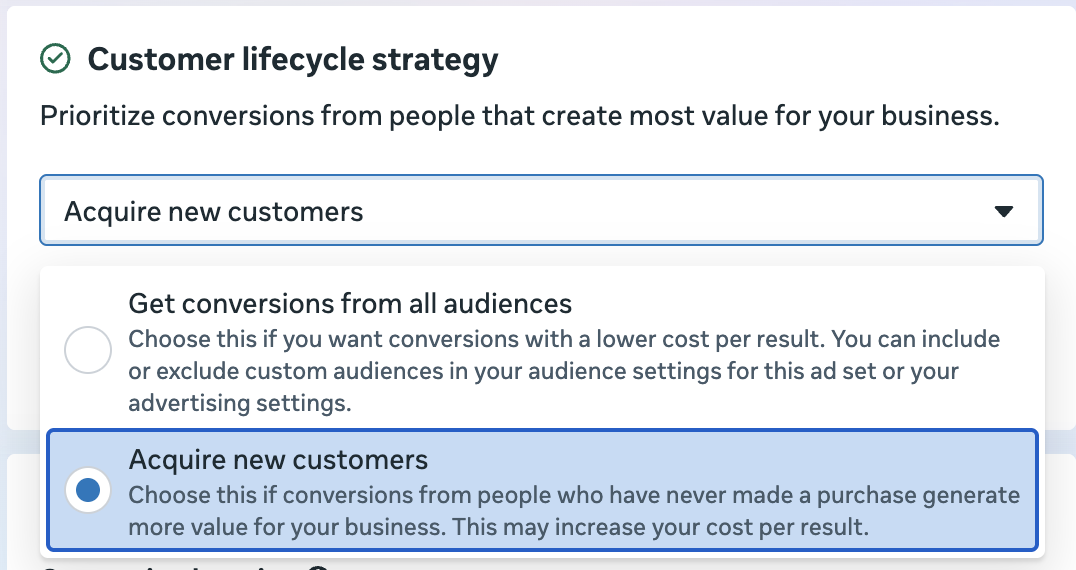
Two things need to happen alongside that test. First, check your audience definitions for accuracy roughly every six months. Audiences can fatigue or even sunset when not in use, purchase windows change, and product catalogs grow. Accurate reporting on new customers is of the utmost importance for Meta's signaling, as well as for directional strategy for ad buying and business management. Second, check your audience breakdowns on a regular cadence to see how spend and performance compare across new and engaged audiences versus existing ones. That weekly habit is what catches a slipping account before it becomes a quarterly problem.
5. Remember That New Customers Are Starting From Zero
Everything about your brand is new to a customer who hasn't bought from you yet. They don't know what problem your product solves, the product names or what they do, your collection names, your SKU colorway names, your founder story, or your unique selling points.
This matters because of how differently Meta and a new customer experience the same ad. Meta might fatigue on a creative that's been running for three years, but that ad is brand new to someone seeing it for the first time. The fix isn't necessarily a full creative reset. Sometimes it means remaking an old ad with new visuals while keeping the same underlying message. Sometimes it means relaunching a fatigued ad specifically into the new "Acquire New Customer" lifecycle option, where it gets served to a fresh pool of people. And sometimes it means taking an old winner as a starting point and rebuilding it entirely with 2026 best practices, current hooks, and current placements in mind.
The goal is to work with the algorithm's need for fresh signal while still giving new customers the introduction to your brand they actually need, even if your internal team is tired of looking at the same message.
Bringing It Together
None of these five things work in isolation. Sharp audience thinking informs which creative pillars are worth building. Strong pillars give you something worth iterating on quickly. Fast iteration gives Meta's acquisition tools better signal to work with. And all of it only works if you remember that the person on the other end of the ad is meeting your brand for the first time.
Meta is building its platform around new customer acquisition right now. The brands that treat it as its own discipline, backed by real audience knowledge, a defined creative structure, a fast testing cadence, and a willingness to test Meta's own tools against your own instincts, are the ones who will keep winning new customers as the platform keeps evolving through 2026 and beyond.
Stop guessing what's working on cold audiences. Start knowing.
Join Foxwell Founders Membership where the top 1% of digital marketers go to find answers, support, and lasting industry relationships. Trusted by agency owners, brand founders, and marketers everywhere.