The Meta Creative Testing Frameworks Top Brands Use in 2026
This post was co-authored by Fairbrother Agency Founder Paul Fairbrother.Why It Matters
If you’re running Meta ads in 2026, creative testing has fundamentally changed. With Meta’s Meta Platforms Andromeda algorithm, success now depends less on precise audience targeting and more on producing high volumes of diverse, high-quality creative that the system can evaluate and scale. This guide explains the two main testing frameworks brands use today—dedicated creative testing ad sets vs. testing directly inside main campaigns—and how to structure your account to find ads that can handle meaningful spend.
Who this matters to:
Media buyers managing Meta ad accounts at scale
DTC brands producing increasing volumes of creative
Creative strategists responsible for testing and iteration
Agencies looking to modernize testing frameworks after Andromeda
In short: if you want your Meta ads to scale without drowning in fragmented campaigns or wasted creative tests, this framework shows how top advertisers are structuring creative testing today.
There’s one question that gets asked more than any other in the Foxwell Founders community:
“How should I set up and run my creative testing?”
In 2025, Meta switched to the Andromeda algorithm, where more emphasis has been placed on increasing the volume of ad creative than ever before. In turn, this has led to even more confusion about how to structure testing frameworks that give us meaningful results at scale.
Keep reading and we’ll unpack the different options to win at Meta ads now. Then, we’ll give some tips on how to optimize your creative pipeline so that you can find more winning ads.
Let’s dive in!
It’s Not 2016 Anymore
Rewind to Meta ads around 2015-2016 and before: Instagram ads were still shiny and new, and video ads had only been around for a couple of years. Stories and Reels weren’t a thing yet, and UGC video content was extremely rare. AI generated ad creative wasn’t even on the horizon.
It was the “golden age” before Cambridge Analytica and privacy policies such as Apple’s iOS changes came in 2021, before GDPR in Europe and before CCPA in California. Back then, you could run very granular campaigns to hyper targeted audiences on Meta ads (back then, it was just ‘Facebook ads’).
The emphasis was mainly on targeting and getting in front of the right people, with ad creative being much less of a consideration.
Fast forward to the present day and targeting options are now very limited, with broad targeting being the norm. Instead, the main lever we can pull is to produce more and better ads to engage with the audience.
The volume of ad creative has grown exponentially, and traditional ways of testing are struggling to keep up.
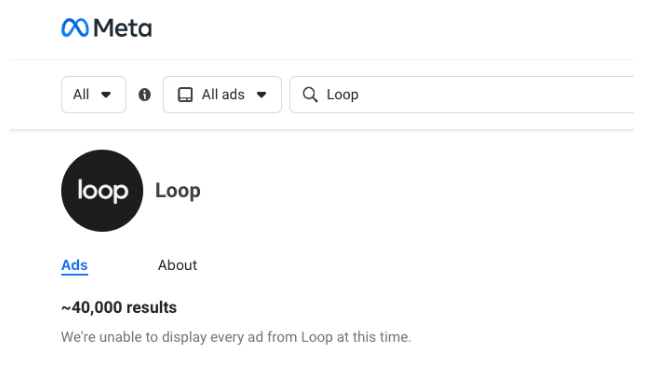
An extreme example is Loop Earplugs who are the GOAT for creative volume, they have so many active ads that Meta’s Ads Library can’t even display them all. They have approximately 2,000 ads running at any one time, with 40,000 total ads in their library. Nevery DTC brand has had to rethink their creative testing structure in this new era.
How To Structure Your Creative Testing In Ads Manager
Let's start by saying this up front: Meta doesn't make it easy for us.
In an ideal world, each ad would be guaranteed to be allocated some budget so that we can let it serve and then evaluate the results in a precise, scientific way.
That doesn’t reflect reality though. If you give Andromeda 10 ads, most likely two or three will get 80% of the total spend, with the rest being starved of budget. To overcome this, we could split each batch of creative into different ad sets, each with its own budget. But to optimize fully, Andromeda loves consolidation and hates ad set fragmentation.
So, we're between a rock and a hard place.
The two main frameworks for creative testing
(Keep in mind we’re looking for the “best compromise” rather than the “perfect solution”).
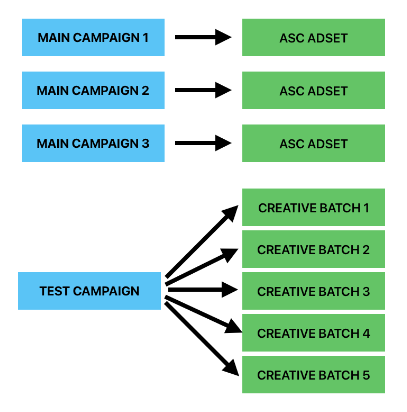
One Batch Of Creative Per Ad set
This one is straightforward: for each new batch of creative, we build a new ad set. By using ABO - Adset Budget Optimization - we ensure each batch has a dedicated budget for testing.
For clarity, a batch of creative has one common theme. For example, this could mean four versions of the same video, each with a different hook, or six lifestyle photos, each with the same text overlay.
The number of ads in a batch is usually between one and ten and they come from the same creative brief.
Pros:
✅ Each creative brief is guaranteed to get some budget.
✅ A dedicated budget means that you can pull some meaningful data from the analytics. From these metrics, you can then uncover why a batch worked or didn’t, and know how to iterate and move forward.
✅ Creative teams are kept happy as every batch gets a decent amount of ad spend, so it doesn’t feel like any ads are wasted.
Cons:
❌ Because learning and optimization still primarily occurs at the ad set level, it means your ads spend more time in the learning phase, which impacts performance and makes it harder to get meaningful results.
❌ Moving over wining ads to your main campaigns can be difficult. We've often seen it where they can’t compete with other stronger batches of creative and stop getting much spend. When we’ve spoken to senior Meta reps, they’ve mentioned that ideally an ad needs 50 conversions before moving it, which is a lot and rarely practical.
❌ With the volume of creative output increasing, things can soon escalate with far too many ad sets to monitor and too much budget tied up for testing.
Test Directly In Your Main Campaigns
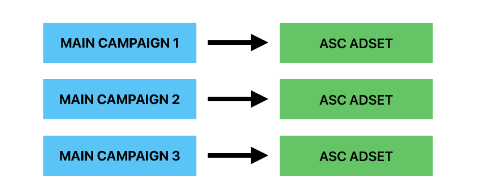
This is the ultimate “sink-or-swim" approach: drop fresh creative directly into your main campaigns rather than having separate testing ad sets.
Often this approach is called “CBO testing” as you’re using campaign budget optimization.
The method is very simple; when you have some new ads ready, just drop them into your main ASC campaigns. Aim to have around 10-20 active ads per ad set running at any one time. This gives Meta and Andromeda plenty to work with, but not so much that it can’t properly evaluate which ads have the most potential.
If you need to add in more creative for testing, just pause any underperforming ads or those that haven't got a significant amount of spend. This works on the principle that if Meta decides not to give an ad enough budget, then no matter how much potential it has in theory, it's never going to scale.
Pros:
✅ Simplicity; media buyers never need to move ads between campaigns, and there are far less adsets to publish and monitor.
✅ Scaling; your main campaigns are always topped up with fresh ads, and scaling is as simple as increasing the campaign budget.
✅ It finds the ads that will spend the most and drive the most conversions.
Cons:
❌ Dropping new ads into a high budget campaign does sometimes come with a risk. Occasionally Meta will favor the ad and instantly give it a lot of spend, but the audience doesn’t like it and it gets a low ROAS. By the time you catch it it’s burnt through a lot of your budget.
❌ Some ads are “wasted”. Nobody likes it when the UGC ad that cost you $300 from a content creator gets $15 of spend after two weeks.
❌ Data is limited. If a batch of creative gets very little spend, it’s hard to generate any conclusions from the metrics, so you don’t know how to iterate and move forward.
Which Framework Should You Pick?
The short answer is that a lot of brands used Method 1 before Andromeda, but have now switched to Method 2 as their creative volume has increased.
A slightly longer answer is: it depends.. It can depend on how far along you are on the journey for creative diversification and creative volume with creative quality simultaneously. For brands with a small creative volume or especially those new to advertising, there’s definitely some advantages with Method 1 and being able to precisely test, learn and iterate.
On the other hand, as soon as creative output starts to scale, we see a lot of successful ad accounts shift to Method 2.
It is, of course, possible to use a hybrid approach. For example, it’s common to see new BAU (“business as usual”) ads put directly into the main campaigns, and then separate out a new product launch or special offer into a separate dedicated ad set or campaign.
If you’ve even clicked on this blog, or found us on Google and are interested in this topic… we’d love to have you in our ad buying membership.
Spend Is Now A Key Metric
Which is the better ad? The one that has a ROAS of 5 but only gets 6 purchases, or the one with a 2X ROAS that has 100 purchases?
Traditionally we’ve focused on “hard metrics” such as ROAS, CPA, CPM and CTR along with “soft metrics” for creative such as thumbstop, hook rates and hold rates.
Now, for high performance brands that are looking to scale, there’s a new key metric in town; spend.
For large budget advertisers, their creative strategists are now trying to find ads that can process a large volume of ad spend without the frequency going too high and then burning out. Naturally metrics such as ROAS are still a priority, but as an ad account grows the battle is often one of how to get new ads to spend significant amounts and generate a high number of sales, not just yield a high ROAS.
Three Ways To Find More Winning Ads To Test
Now that we’ve covered what testing framework to use, let’s turn our attention to some tips on how to ensure we maximize the potential of each test.
It’s a large topic, so today we’re going to distill it down to just three key points.
1. Creative Volume
As the famous line from the movie Jaws says, "You're gonna need a bigger boat". Simply put, to find more winning ads on average we need to test more ads.
Since Andromeda launched, we’ve seen brands that have doubled their creative volume. This isn’t easy, both in terms of logistics and also cost. This is usually something that is built up over time, so that the increase in revenue can cover the rise in overheads from the creative agency or in-house studio.
How much creative do you need? From auditing many accounts, the short answer is usually “more than you’re currently producing”.
It’s hard to give an exact figure as it depends on your CPA (the lower it is, the faster you can test) and your current win rate for new ads. But if we had to give a guide, many new advertisers aim for a new batch of creative once a week. Mid-sized advertisers are aiming for 40-50 new ads per month, and larger brands are looking at 100 ads per month and anything upwards from there.
There are outliers, we’ve heard of large advertisers with just a handful of new ads per year. But it’s rare.
2. Creative Quality
Time for some honest talk: increasing creative volume often causes ad performance to drop.
Wait, what? We just said more creative volume is essential!
The issue is that when creative studios are tasked with producing more assets, often they just churn out more images and videos to “check the box”.
Tracking monthly ad volume is essential, but don't let KPIs take over.
That does not mean it needs to have a polished, high production look. Far from it, “ugly ads” or “lo-fi ads” are totally fine and often perform best. What it means is that every ad needs to be well thought out and specifically designed to generate sales.
Before approving any piece of ad creative, always ask: Could this ad potentially spend $10,000? If the answer is no, take the time to improve it, or if you can’t, just scrap it and move on to a new brief.
Don't generate tests just for the sake of increasing volume.
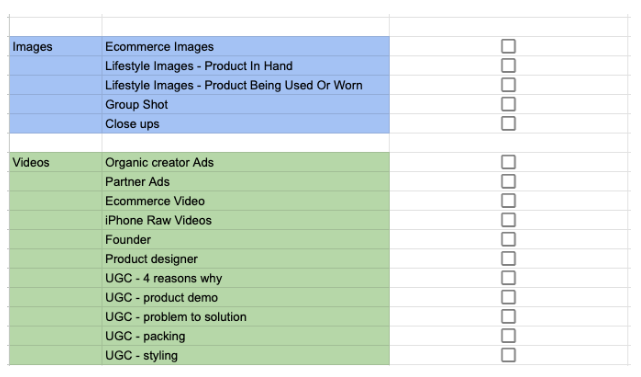
3. Creative Diversity
Back to 2016 again: creative diversity simply meant testing images and videos.
In 2021, diversity became a lot more sophisticated with the inclusion of UGC style video.
In 2026, the variety of formats we use has exploded:
Product renders
Lifestyle photos
Flat lay images
Product render video
Founder video
Employee video
Partnership ads
Unboxing videos
Reviews / testimonials
TikTok-style videos
"Four reasons why" video
AI generated creative
And so on, the options are endless.
Tip: for major campaigns and product launches, consider having a creative diversity checklist so that you can ensure you have enough diversity. It will look different for every brand, but a simple one we use:
Final Thoughts
If you’ve been running ads for a while, there’s a strong chance that your approach to testing hasn’t kept up with the significant increase in creative volume. You’re not alone, so many of us have had to stop and take a look at “the way we’ve always done things” and re-evaluate.
So take the opportunity to take a step back and audit your account and frameworks, or get an external view from the Foxwell Founders community which regularly runs audit sessions. If you’ve found that your ad account complexity has been creeping up over time, with lots of fragmentation and ad sets stuck in the learning phase, it’s now time to lean more on CBO testing.
Andromeda has changed the way we conduct our testing. The good news is the new methods are easier for media buyers, both in terms of publishing and also daily monitoring. Less work and more scale is a nice outcome for everyone.
Nerdy or not, this stuff is exactly what we’re discussing every day in the Foxwell Founders Membership. Interested in what we’re doing over there? We’d love to have you!