UGC WTF? How Media Buyers & Creators Actually Win Together
Why It Matters
UGC efforts often stumble not because creators lack skill, but because brands and media buyers fail to align with how performance truly works. Successful UGC isn't about crafting the perfect ad; it’s about trusting creators to be authentic, prioritizing clear messaging over gimmicks, and establishing a system for ongoing testing rather than chasing one-off viral moments. Ultimately, real success comes from collaboration between creators, media buyers, and strategic planning to create a scalable approach.
With Courtney Fritts
Most brands say they value UGC. Fewer actually know how to work with creators in a way that produces consistent, scalable performance.
In this episode of Scalability School, Courtney Fritts breaks down what’s really happening behind the scenes when UGC works and why it so often doesn’t. Courtney brings a rare perspective: she’s both a media buyer and a UGC creator, managing accounts from $3k/month to $1M+/month in spend while also producing content herself. The result is a practical, no-fluff look at how creators, media buyers, and brands should actually collaborate.
The Biggest UGC Myth: “Good Ads Always Spend”
One of the most frustrating realities for creators:
A great ad doesn’t always get spend.
Courtney explains that creators often assume performance equals quality. But in reality, the algorithm decides what gets delivery—not the creator’s confidence or portfolio.
Media buyers regularly see:
Ads that look amazing but stall at $2–$100 in spend
Creatives that pass every gut check but never exit learning
“Good” ads that simply don’t align with algorithmic signals
The takeaway: performance isn’t personal. A creative can be solid and still fail due to timing, structure, audience, or platform dynamics.
Why Some “Bad” Ads Print Money
One of the most counterintuitive lessons Courtney shares: Your best performing ad might have a terrible hook rate.
She references creatives with:
~20% thumb-stop rates (well below best practices)
Extremely high conversion efficiency
Long, sustained spend ($500k+)
Why? Because those ads filter fast. They repel the wrong audience immediately and retain only people who actually care—driving higher downstream conversion.
Not every ad needs to stop everyone. Some ads are designed to qualify.
Creative Styles That Are Working Right Now
Courtney highlights a few formats brands can test immediately:
1. Split-Screen Hooks
Vertical split screens add stimulation and visual contrast in crowded feeds. Simple, effective, and working across accounts.
2. Ugly Statics (Yes, Really)
Many brands see statics fail all year—then suddenly dominate in Q4. Clear, bold, Canva-style graphics with strong contrast often outperform polished design during high-intent periods.
“Not uglier is better. Clear is better.”
3. “This Is an Ad” Creative
Trying to disguise ads as lifestyle content often backfires. The fastest path to performance is:
Show the product early
Explain what it is
State the price or value clearly
Users already know it’s an ad. Transparency converts.
The #1 Thing Killing UGC Performance: Over-Briefing
Courtney is blunt here: Overly rigid creative briefs destroy authenticity.
Common mistakes brands make:
Writing word-for-word scripts for non-actors
Forcing shot lists that are logistically unrealistic
Copy-pasting the same brief to every creator
Great creators need talking points, not monologues. The more a creator can use their own language, the more believable the content becomes.
How Courtney Evaluates Creators (Hint: It’s Not Case Studies)
When hiring creators, Courtney:
Skips logos and brand lists
Ignores case studies initially
Focuses on feel
She asks:
Do I trust this person?
Do they sound natural?
Do they look like the user they’re meant to represent?
If the authenticity isn’t there, performance rarely follows—no matter how impressive the resume looks.
What Creators Don’t Understand About Media Buying
Creators often ask: “Why didn’t my ad spend?”
The answer is simple but uncomfortable:
The algorithm is unpredictable
Media buyers can’t force success
Testing often requires major structural changes
Courtney compares the algorithm to a toddler—you let it roam until it’s about to hurt itself, then intervene. Winning creative must serve two masters:
The consumer
The algorithm
Ignoring either breaks performance.
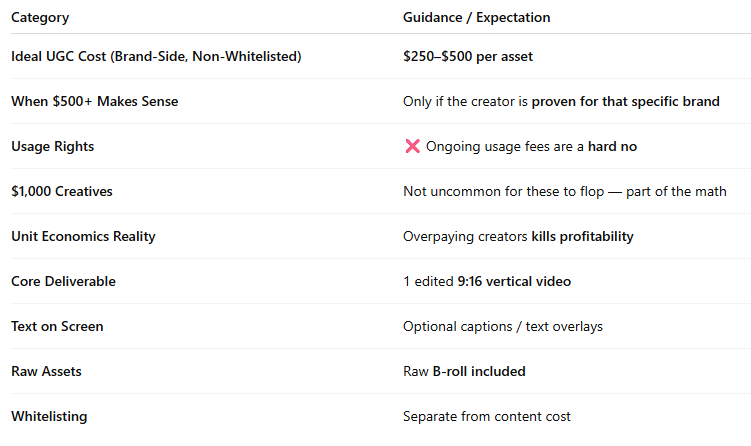
What UGC Should Actually Cost
Stop Asking Creators to “Go Viral”
Virality is random. Systems are not.
Courtney emphasizes:
Creative volume matters but quality matters more
No one knows which ad will win ahead of time
The best performers are often obvious after they work
Chasing trends, memes, or “what Twitter says works” usually leaves performance on the table.
Final Takeaway
If there’s one message from this episode, it’s this:
UGC works best when creators are trusted, briefs are flexible, and performance is evaluated with nuance and not ego.
The brands winning with UGC aren’t chasing hacks. They’re building repeatable systems, respecting creators, and letting clarity beat cleverness every time.