

Meta’s Generative Ads Model (GEM): What Meta Advertisers Need to Know
Why It Matters (for Meta Advertisers, Media Buyers & Creative Strategists)
GEM changes how Meta decides which ads people see and their order. It moves success from manual targeting to creative systems, sequencing, and data quality. Advertisers who build diverse, story-driven creative libraries and let the algorithm learn will become more efficient and grow. In contrast, those who stick to narrow targeting, single “hero” ads, and constant resets will gradually lose performance.
Meta has introduced a new AI “brain” for its advertising platform called the Generative Ads Model (GEM). Launched in 2025, GEM is a foundational AI model designed to boost ad performance and advertiser ROI by delivering more relevant, personalized ads to each user.
In essence, GEM analyzes vast amounts of data across Facebook, Instagram, and other Meta properties to better predict which ads (and, importantly, sequences of ads) will resonate with each person. Since its quiet rollout in early 2025, Meta has reported that GEM has already driven a noticeable uplift in results – According to Meta, GEM has driven a 5% increase in conversions on Instagram and 3% on Facebook Feed on average since going live. Those gains doubled in the following quarter as Meta refined the model.
For advertisers, the arrival of GEM marks a significant shift toward AI-driven advertising. This article explains what GEM is, how it changes ad creation workflows, the new capabilities it enables, and what it means for campaign performance and strategy. The goal is to help Meta advertisers understand and leverage GEM’s innovations for better results.
What Is GEM and Why Does It Matter?
GEM (Generative Ads Recommendation Model) is Meta’s most advanced ads optimization model – essentially a new central AI “mind” steering ad delivery across Meta’s apps. It’s built on large-scale machine learning principles similar to those behind large language models, but applied to ad recommendation. According to Meta’s engineering team, GEM was trained at an unprecedented scale (thousands of GPUs, LLM-level parameters) to serve as the core of Meta’s ad ranking system. Its purpose is to improve relevance and performance across the entire Ads platform, learning patterns from enormous datasets of user behavior and advertiser content.
Meta’s official messaging highlights GEM’s ability to enhance ad relevance and ROI. By acting as a unified model that shares learnings across Facebook, Instagram, Messenger, and more, GEM can identify the right ad for the right user at the right time. Previously, each placement (e.g. Instagram Stories vs. Facebook Feed) had separate optimization models; now GEM bridges those silos. For example, if a user tends to engage with video ads on Instagram but scrolls past videos on Facebook, GEM will learn that and prioritize showing them video content on Instagram for better results. It also looks at a person’s journey over time and across devices – when they browse, when they purchase – to adjust ad delivery dynamically. Overall, Meta calls GEM the new “central brain” of its ad system, able to deliver more relevant and personalized ad experiences aligned with people’s preferences while improving advertiser outcomes. Surprisingly, this confirms that Meta's platforms previously operated in silos – a limitation GEM now eliminates.
In short, GEM matters because it promises higher performance with less manual work. It continuously fine-tunes ad targeting and sequencing in the background, which can increase conversions and return on ad spend for advertisers. Think of GEM as an artificial media buyer working behind the scenes making all the manual targeting and sequencing tweaks we used to do by hand in ads manager.
Join the Foxwell Founders Membership with 600+ expert digital marketers, agency owners, e-commerce brand owners, and more. We’d love to have you.
Integration with Meta’s Ad Tools
One important thing to note is that GEM isn’t a feature you turn on – it’s baked into Meta’s advertising platform. Meta began running GEM in the backend around Q2 2025 for all advertisers, with no opt-in required. Whether you’re spending $500/month or $500,000/month, your Facebook and Instagram campaigns are already being influenced by GEM’s algorithms.
Meta Ads Manager: From the advertiser’s perspective, the workflow in Ads Manager remains familiar – you still create campaigns, ad sets, and ads. But under the hood, GEM is now powering the auction and delivery decisions. If you were limiting placements or using very narrow targeting before, you might want to loosen those constraints to let the AI “learn” and optimize. Again, Meta would like you to think of GEM as an extension of the media buyer, working algorithmically behind the scenes.
Meta has also updated its best practices to recommend waiting at least 7 days before making major edits to a campaign (up from the old 3-4 day rule) so that GEM has enough time to gather data and stabilize performance.
Under the hood, Meta’s ad stack has multiple AI components working together. Andromeda is the delivery engine that decides which specific ad to show, Lattice is a massive model handling ad ranking, and GEM is now the intelligence that feeds insights into both.
For example, Andromeda uses signals from GEM to serve the optimal ad, and Lattice uses GEM’s outputs to rank ads more effectively. GEM acts as the “central brain” feeding insights to these systems across the ad network.
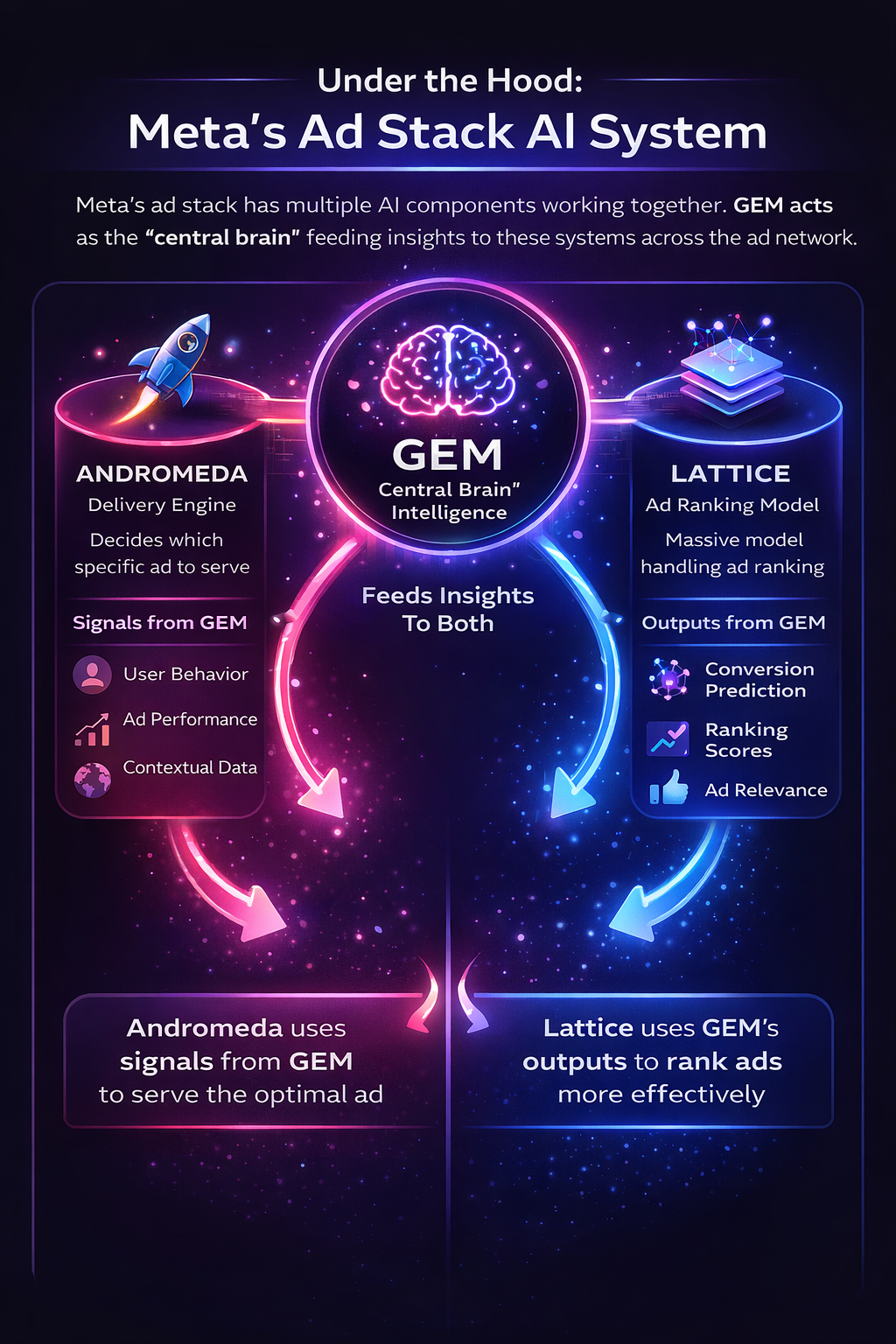
The integration of GEM into Ads Manager and Advantage+ is seamless – advertisers don’t have to do anything special to “enable” it, but should adjust their strategy to make the most of it.
New AI-Powered Creative Capabilities
GEM is part of a broader push by Meta to introduce generative AI features for ad creative, making it easier for advertisers to produce effective ads. As advertisers, we've had these tools – the dreaded 'AI Enhancements' – forced on us over the last year and it hasn’t always been a smooth process. There has been a lot of mistrust and unexpected behavior.
But, as with most Meta rollouts, these tools will mature and improve and as that happens they will better work hand in hand with GEM to accomplish its core mission: making ads more relevant and tailored to each user. By automating parts of the creative process, Meta enables advertisers to quickly produce multiple ad variants and formats. This greatly aids testing and personalization, since GEM (the “brain”) can then mix and match the best creative for each audience segment or individual.
Meta’s aim is clearly to streamline ad production – injecting AI into the creative layer to make ad creation faster and more scalable.
How GEM Changes Ad Creation and Campaign Workflows
GEM’s introduction fundamentally changes how advertisers approach Facebook and Instagram ad campaigns. In the past, success on Meta’s ad platforms often required intensive manual optimization – narrowing down audiences, finding a “winning” creative, and milking it, while constantly tweaking budgets or duplicating campaigns to stay ahead. With GEM, much of that manual micromanagement becomes less effective, and a new playbook is emerging.
Here are the major shifts in workflow and strategy for advertisers:
From One-Off Ads to Multi-Ad Sequences: This is crucial - previously, Meta’s algorithm would simply pick the single best ad and show it as much as possible. Now, GEM optimizes across a sequence of ads, orchestrating a person’s journey from first impression to conversion. It looks at “what order of ads usually makes a user buy” rather than treating each ad in isolation. This means advertisers should design campaigns as funnels or storytelling sequences, not just one-off ads. Think in terms of a series of creatives each serving a purpose: an eye-catching teaser, followed by an educational piece, followed by a testimonial, and then a strong call-to-action offer.
ACTION ITEM: In practice, you’ll want to supply a diverse set of ads that GEM can rotate through to find the right sequence for each user. For example, a potential customer might first see a short video that sparks curiosity, later an ad that addresses a problem your product solves, then a carousel showing social proof or reviews, and finally a discount offer – GEM will decide who sees which and in what order, based on what the system predicts that user needs to convert.
Need for More Creative Variety: Because GEM is matching different creatives to different users (and learning what works for each persona), advertisers need a larger pool of creatives and angles than before. It’s been observed that ads “die” faster now – a single ad might not sustain performance as long because the algorithm quickly saturates the audiences for whom that one message is optimal. Meta’s system now expects many ad concepts for different types of users, so it can swap in fresh messages to the right segments.
ACTION ITEM: In addition to funnel diversity you will want to ensure you have plenty of different creative types in the mix - images, gifs, low fi videos, high production videos, carousels, etc.
Less Emphasis on Manual Targeting: GEM’s strength is finding the right audience for your ads through its AI. Meta has been reducing manual targeting options for a while (e.g. removing many detailed interest targets) and encouraging broader targeting, and GEM accelerates this trend.
ACTION ITEM: This doesn’t mean you can’t target at all, but it does mean you should lean into Meta’s AI automation. Your campaign setup might become simpler (fewer ad sets, broader definitions), shifting the focus to creative and messaging instead of audience splits.
Longer Learning Phases & Fewer Resets: With GEM evaluating more signals (across apps and over time), it needs sufficient data to optimize. Frequent edits or resets to campaigns now carry a bigger penalty, as they wipe the learning that GEM has accumulated. Advertisers are strongly advised to avoid the old habit of “day-trading” the Facebook Ads Manager – i.e. turning campaigns on and off, duplicating ad sets to exploit the algorithm, or making sudden budget changes every 48 hours. Instead, pick a strategy and let it run for at least a week to allow GEM to fully calibrate. If performance is shaky in the first few days, resist the urge to restart; what you’re seeing could be the AI testing various combinations. Meta’s updated recommendation is to wait 7+ days before major changes so that GEM has a stable window to learn.
ACTION ITEM: Be patient, give the algo some time to learn on new campaigns. Advertisers who constantly intervene and reset learning may get stuck without ever letting the AI achieve stable performance.
Focus on Creative and Data, Not Lever-Pulling: Overall, GEM shifts the advertiser’s job from micro-optimization to creative strategy and data quality. We have truly reached the era of Creative As Targeting. Advertisers should therefore invest more time in crafting compelling, diverse creatives and feeding the algorithm plenty of it, rather than obsessing over manual targeting rules. Additionally, data integrity is crucial to GEM’s success. Ensure your Pixel or Conversions API are set up to track deeper funnel events (Add-to-cart, subscriptions, purchases, etc.), not just clicks or leads. GEM uses those signals in its modeling of user journeys. Brands with better data (accurate conversion events, offline uploads, high match quality) give GEM more to learn from, and will gain an edge. It’s worth auditing your Meta Pixel and offline event setups to make sure you’re sending complete, high-quality data
ACTION ITEM: Your competitive advantage with GEM comes from what the AI can’t do – producing original creative content and ensuring data integrity – rather than manual bidding tricks. Invest time and resources into creative strategy, creative execution, and data integrity.
Embracing the GEM Era
GEM represents a fundamental evolution in how Meta's advertising platform operates. It’s not just another feature update, but a complete reimagining of ad delivery architecture. The shift from siloed placement optimization to a unified AI brain that orchestrates multi-ad sequences across Meta's entire ecosystem changes the game for advertisers in profound ways.
The implications are clear: the era of manual lever-pulling and day-trading in Ads Manager is over. Success with GEM requires accepting a new reality where patient, strategic thinking beats tactical micromanagement. Advertisers who continue chasing yesterday's playbook – narrow targeting, single winning creatives, constant campaign resets – will find themselves fighting against the algorithm rather than working with it.
Instead, GEM rewards those who feed it what it needs: diverse creative assets that tell a story, clean conversion data that maps the customer journey, and the patience to let machine learning do its work. Your role as an advertiser is shifting from operator to strategist. While GEM handles the complex orchestration of who sees what ad and when, you focus on what machines can't replicate – understanding your customers deeply enough to create messaging that resonates and ensuring your data infrastructure captures meaningful signals.
For many advertisers, this transition will feel uncomfortable. Giving up granular control in exchange for algorithmic optimization requires trust that doesn't come easily, especially with how unpredictable and volatile the AI rollout has been on Meta. But the reported performance lifts – and the trajectory of Meta's continued improvements – suggest that resistance is futile. GEM is already live across all accounts, learning and optimizing whether you adapt your approach or not.
The advertisers who will thrive in this new landscape are those who embrace the shift fully: building creative systems rather than hero ads, thinking in customer journeys rather than isolated conversions, and measuring success over weeks rather than days. GEM isn't just changing how ads are delivered – it's redefining what it means to be an effective Meta advertiser.