

Q4 Budget Planning When Meta Ads are 80%+ of Your Marketing Spend
Written by Courtney Fritts
Why It Matters
When Meta makes up the majority of a brand's marketing spend, Q4 budget planning (and therefore Meta budget planning) starts in July or August, and everything should be nearly set by September.
The brand is relying on that spending number to make real decisions: how much inventory to hold, how many people to schedule on the fulfillment floor, and how much creative needs to be in production before Black Friday hits.
That kind of concentration means the budget conversation has to go further than "let's spend more than last year." It needs to connect a dollar figure to an order volume, an order volume to a fulfillment plan, and a spend number to each day and week of the peak holiday season.
Start With Last Year, Adjusted for the Calendar
The starting point is always the previous year's actual spend, broken out by day (not by week or month).
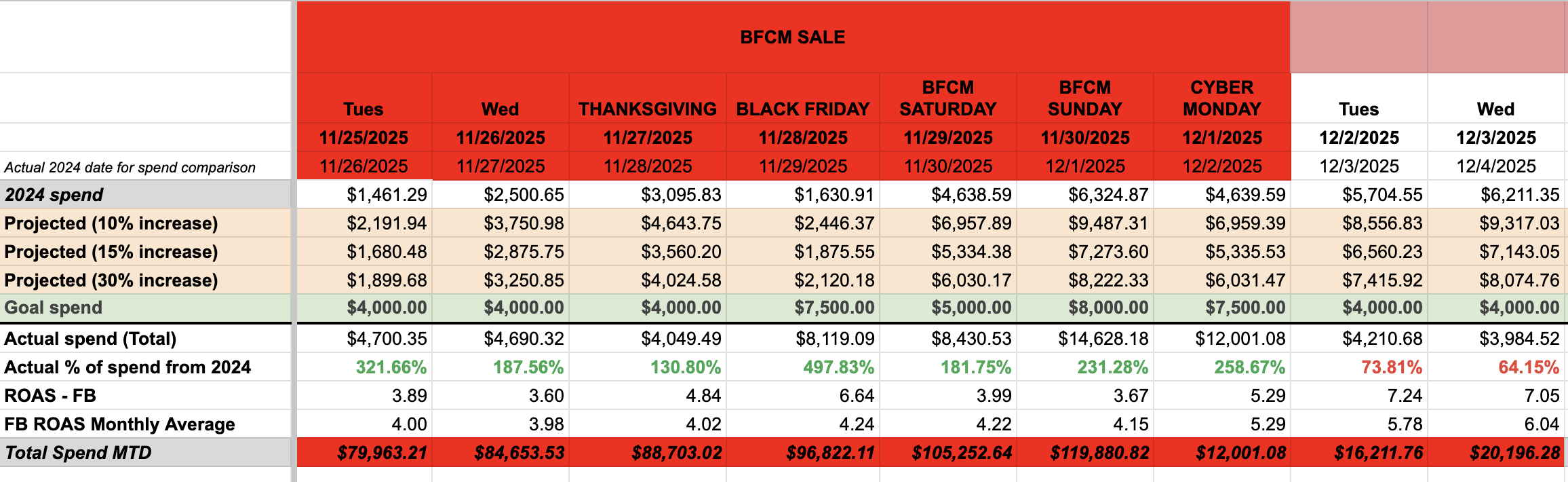
This is a budget planning template shared in the Foxwell Founders Community. Join today to gain access.
Be sure to adjust the days so that BFCM weekend lines up: Thanksgiving (Thursday) to the same day last year, Black Friday the same day, and so on. You'll likely skip a day or double up a day to get it accurate, but this step is important, and it's worth it. Every projection built on top of this baseline is only as accurate as the calendar alignment underneath it.
Build Multiple Growth Scenarios, Not One Number
Once last year's spend is aligned by day, the next step is layering in growth scenarios rather than picking a single increase and running with it. A simple spreadsheet formula applied against the daily baseline can generate scenarios at 15%, 25%, 35%, and 40% (or higher) year-over-year growth, and each one becomes its own column running through the full November and December calendar.
This matters because the brand, not the media buyer, ultimately owns the risk tolerance for Q4. Showing a conservative scenario next to an aggressive one, side by side with the dollar and order implications of each, turns "how much should we spend" into a decision the brand can actually make with full information instead of a number handed down without context. Be sure to also include any other numbers in these scenarios that are important to the brand: Contribution Margin, MER, Revenue minus ad spend. Whatever the decision-makers need to truly visualize each option for budget aggression, show it.
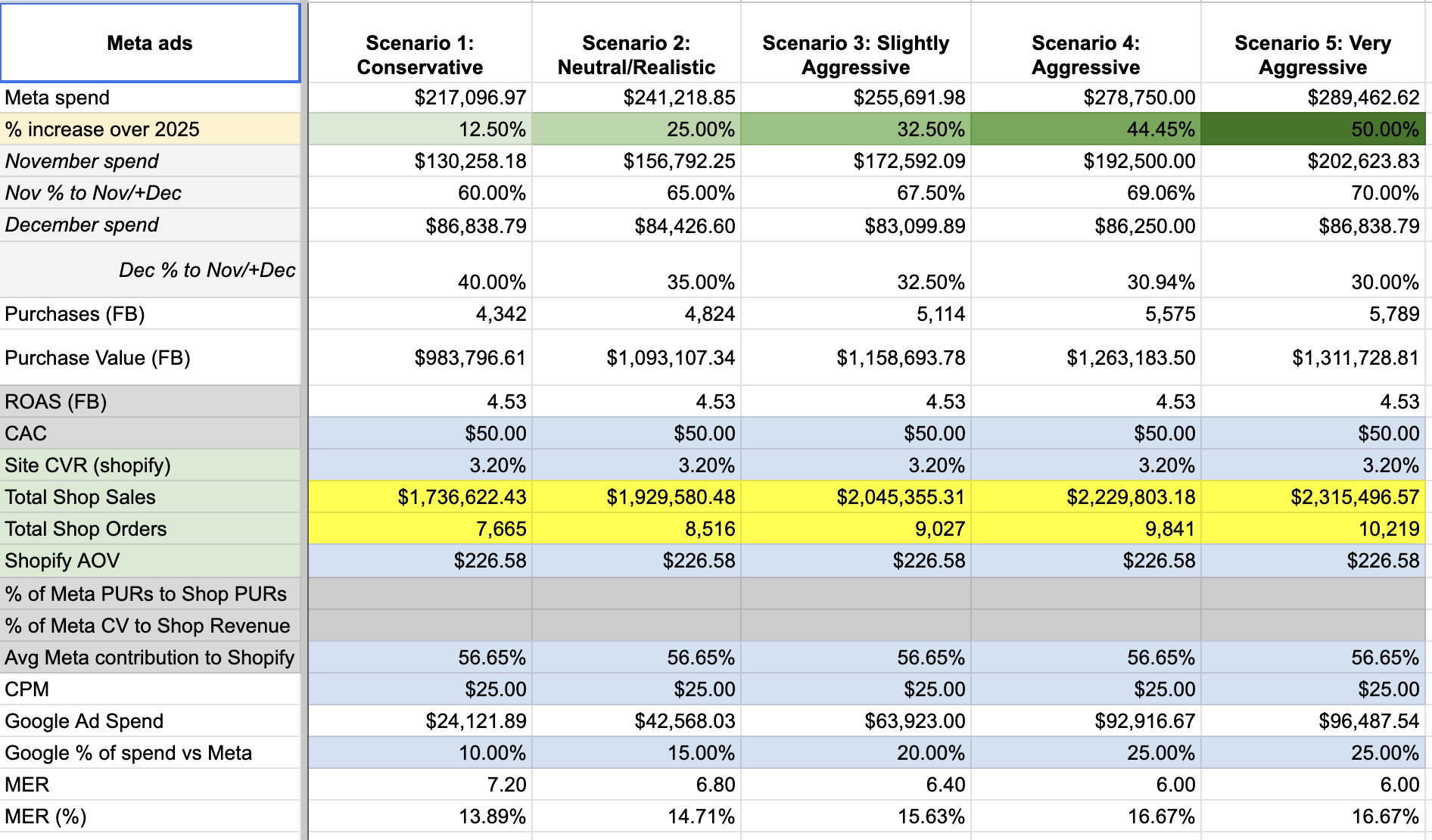
For brands with a giftable product, the shape of the spend curve matters as much as the total. A brand running an early-November promotion, a mid-November discount event, and a full-price Black Friday push needs its budget weighted differently than a brand that saves everything for the last week of November or for early-to-mid-December. Splitting the total between November and December, for example 65/35 in an aggressive scenario versus 55/45 in a conservative one, lets the brand see how much room they're giving themselves to push harder in December if fulfillment stays ahead of schedule, or pull back if it doesn't.
Going more aggressive earlier in November also has an operational upside beyond the ad account. It buys the fulfillment team more runway to work overtime and get everything shipped before the December cutoff, instead of compressing all of that pressure into the final two weeks before Christmas.
It's important to know that game-time decisions and changes can be made in November and December, but early planning dictates things like seasonal hiring, creative production, landing page needs, and more. Brands can always scale DOWN on spend if things are going too well. It's much harder to turn up the gas on an ad account in late November if things aren't going well yet if the brand isn't prepared with all the aforementioned aspects of what it takes to scale an account in Q4. It's better to start off (too) strong in November and turn it down than the other way around. In the same manner, you can't turn up November spend and performance once you're in December, so keep that in mind when looking at the November vs. December split.
The sharpest takes on Meta ads and creative strategy, free, focused, and worth your inbox space.
Turn Spend Into Orders, Not Just a Budget Number
A spend (or even revenue) number on its own doesn't tell a fulfillment-driven brand what it needs to know. What it needs is an order forecast, broken out by week (or maybe even by day), so it can staff accordingly, or if using a 3PL for packing and shipping, letting them know in advance so they can plan accordingly and not get behind on fulfillment and shipping.
Getting there means converting projected spend into projected orders using two assumptions pulled from historical performance: an average customer acquisition cost, and the percentage of total Shopify purchases Meta is actually driving. Blending the percentage of Meta-attributed purchases against total Shopify purchases (over a specific and long-term time window – in the Founders Membership example, we took the average of November + December 2024, November + December 2025, and January - July 2026 to get the average of all three for this calculation), alongside the percentage of Meta-attributed revenue against total Shopify revenue, gives a more realistic ratio. In the Founders Membership example shared, that blended ratio landed around 56%, meaning roughly 56% of total Shopify orders were ones Meta's in-platform data reported credit for.
Dividing projected spend by the target CAC gives a raw count of Meta-attributed purchases. Dividing that number by the blended attribution ratio scales it up to total expected Shopify orders, which is the number the fulfillment team actually needs. For a business that fulfills in-house, that weekly order forecast is what determines whether they need to bring on temporary help, extend hours, or hold steady with the current team.
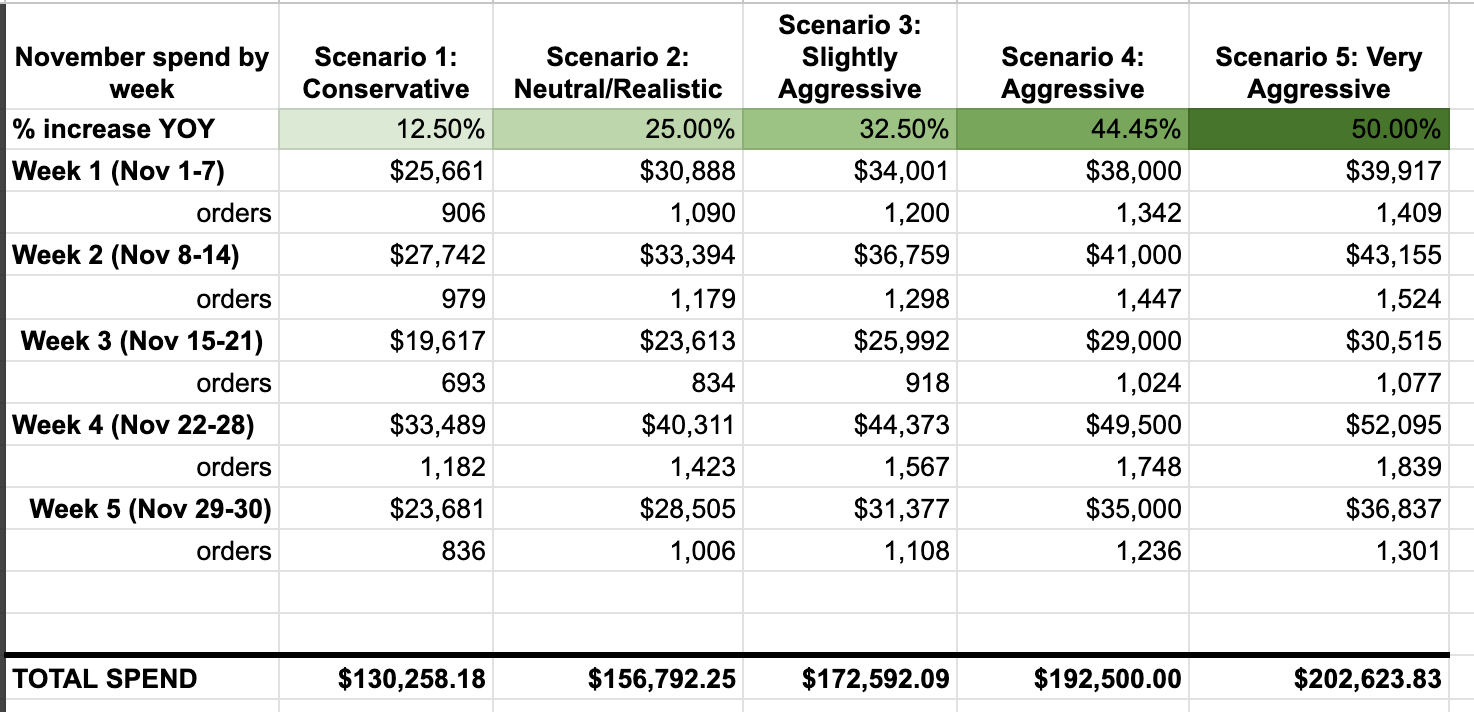
These ratios shift seasonally, too. A brand with a strong gifting angle often sees its CAC improve in November and December even as CPMs rise across the platform, because purchase intent is simply higher. Basing the CAC assumption on past Novembers and Decembers, rather than a full-year average, keeps the forecast closer to reality.
Let Meta Spend Set the Google Number
For brands who are this disproportionate on Meta ad spend, Google spend shouldn't be planned in isolation. It makes more sense as a percentage of the Meta relationship to total marketing spend, tested as its own set of scenarios alongside the Meta projections. For e-commerce, usually a healthy Meta to Google ads split can be anywhere from 80% Meta/20% Google to 60% Meta/40% Google. That approach keeps the channel mix consistent regardless of which growth scenario the brand ultimately picks, and it gives a clear dollar figure for Google spend the moment the Meta number is finalized rather than requiring a separate planning exercise.
Also keep in mind where the customer is at in their buying cycle during the holiday season. Generally, October and November are for demand generation to try to convince someone why they need to buy your product as a gift this holiday season, or get it added to their list to buy for someone. Come December time-frame, many times this then switches to demand capture when people are last-minute shopping for exactly what they already know they are shopping for. This means that the November/December split of Google for demand capture may be more heavily skewed towards December, whereas Meta may spend more heavily in November. Use the platforms and how your customers use them in the holiday season to your advantage. So even if you choose an 80% Meta/20% Google split, and even if Meta is spending 65% of the November + December budget in November and 35% in December, if it works for your brand and the data says to, consider flipping the Google breakdown in spend to 30% of November + December's spend in November, and 70% in December before the shipping cutoff.
Putting this Into Action
This walk-through produces a planning document that a brand can actually use to make Q4 decisions across the entire business, not just inside the Meta or Google ad account. The daily calendar-adjusted baseline keeps the model honest. The scenario range gives the brand a real choice instead of a single imposed number. The order forecast connects that choice to staffing and fulfillment. And the Google allocation keeps the rest of the media mix consistent no matter which scenario wins.
For any brand where Meta carries a majority of the marketing budget, that level of detail is the difference between a Q4 plan the whole business can execute against and a spend target that only makes sense inside the ads manager.
This is the kind of prep work happening daily inside Foxwell Founders, where 600+ expert Meta advertisers stress-test plans like this before Black Friday.