

Scaling Meta ads for Black Friday/Cyber Monday
Why It Matters
Scaling Meta ads goes beyond just bumping up the budget; it’s about increasing spend while maintaining solid performance. If you scale improperly, you could see rising costs and unstable results. To navigate this, align your scaling approach with your comfort for risk—consider slow increments for stability, horizontal scaling for better control, or manual bids for quicker results, albeit with more complexity. Remember, faster scaling brings more risk, so use safeguards like rules and caps to protect your budget. Ultimately, the key is finding the right balance between speed and stability that aligns with your brand’s goals.
One of the most common questions we get in the Foxwell Founders Membership about Meta ads is how to scale spend without breaking what's working. It's a fair question – taking an account from $1,000 to $10,000 or more per day isn't as simple as adding a zero to your budget.
We’ve scaled multiple accounts from four (and even three) to five figures in daily spend. While there's no perfect formula, there are definitely patterns that work more reliably than others.
Before diving into specific scaling methods, it's worth understanding why increasing budget isn't as straightforward as it seems. When you push more spend through an account, you're asking Meta's delivery system to find significantly more conversion opportunities at the same efficiency level.
This means reaching beyond your best audiences, competing more aggressively in the auction, and often triggering algorithm resets that can destabilize performance. We've seen plenty of accounts where doubling the budget led to tripling the CPA, even with the improvements Andromeda has brought to campaign structures. The key is recognizing that each scaling method comes with different trade-offs between speed, stability, and the amount of active management required.
If you’ve even clicked on this blog, or found us on Google and are interested in this topic… we’d love to have you in our ad buying membership.
A quick TL;DR if you’re in a hurry to build for BFCM:
Scaling Meta ad accounts successfully comes down to matching your method to your situation. If you have time and want maximum stability, the slow and steady 20-25% increases will get you there with minimal drama. Need to move faster? Horizontal scaling gives you more control than pure budget increases, while automated rules can handle the mechanics if you set appropriate guardrails.
For those comfortable with more advanced techniques and active management, manual bid campaigns offer the fastest path to scale while maintaining efficiency – just make sure those safety rules are in place. We've scaled accounts from $1,000 to $20,000 per day using various combinations of these methods, and the truth is there's no single "right" way. Start with what feels manageable based on your experience level and situation, test more aggressive approaches if you feel comfortable doing so, and always remember that any scaling method beyond slow incremental increases involves accepting some degree of risk. The key is choosing the risk profile that matches your business needs and management capacity.
Now … for the good stuff:
Slow and Steady
Our default approach to scaling is what we call "slow and steady" – increasing budgets by 20-25% at a time, then waiting a full day to assess performance before making the next move. Yes, it takes patience. Going from $1,000 to $5,000 per day this way requires multiple increments over several days.
But this method tends to preserve performance because it gives the algorithm time to adjust delivery without shocking the system. We've taken accounts from $1,000 to $20,000 per day using this approach, and while it requires discipline to resist moving faster, the compound growth adds up. The stability you maintain often means better overall ROI compared to aggressive scaling that causes wild swings in performance.
The Aggressive Approach
That said, sometimes you need to move faster – whether it's capitalizing on seasonal demand, a specific promotion, a needed revenue bump, or unique events such as Black Friday. The most straightforward aggressive approach is simply doubling the budget. Plenty of people will tell you this works fine now with Andromeda's improvements to campaign optimization. While we've seen it work occasionally, we’ve also seen it lead to unstable performance for several days after dramatic budget increases – costs spike and you're left trying to decide whether to ride it out, roll it back, or kill it and start over! It's not that it never works, but it's essentially a coin flip with your ad spend. If you have a high risk tolerance and a major need for more spend it can work…but if not it’s likely not your best approach.
Horizontal Scaling
A more controlled way to scale quickly is through what we call horizontal scaling – essentially building out rather than up. Instead of pushing more budget through existing campaigns, you launch additional campaigns or ad sets at higher starting budgets. You can even duplicate your winning campaigns entirely and launch them at elevated budgets, letting them run in parallel or, once you’ve established the higher budget campaign is performing, moving exclusively to that one (and scaling it slow and steady from that higher starting point).
While it isn’t ideal to have 2 campaigns running in parallel with the same targeting, optimization and ads, this can be a safer alternative to simply doubling the budget of your campaign. If your higher budget campaign doesn’t perform you still have your good performing lower budget one to use.
Another way of horizontal scaling is, instead of duplicating exactly what you already have running, you launch additional campaigns or ad sets using different audiences, different bidding strategies, and/or using different ads. You can start these at higher budgets as well, though depending on exactly how fast you want to scale it may be sufficient simply to launch these additional horizontal campaigns at a comparable budget to what is already running.
Some suggestions for horizontal scaling:
Supplementing a broad targeting campaign with one with suggested interests (or vice versa if your main campaign is already leveraging suggested interests).
Taking your historical top performers and breaking them out into a “historical winners” campaign.
Creating a new campaign with ads featuring a different product or offer, such as a bundle or buy one get one.
Layering in a campaign optimizing for Value of conversions vs amount of conversions (or, if your main campaign is already a Value campaign, running one for amount of conversions).
Supplementing your main campaign(s) with bid cap or cost cap campaigns.
… We’ll come back to that last one in a bit.
Automated Rules Scaling
Another approach to scaling is using Meta's automated rules to handle those decisions. The setup is straightforward: create rules that increase budgets by a set percentage or value whenever campaigns hit specific performance benchmarks.
For example, you might set a rule to increase budget on your ad sets by 25% if you’ve spent at least a certain amount that day and the ROAS is at an acceptable level. Here is an example of what that might look like - in this example it runs every 12 hours, so you could potentially scale twice in the same day if you are hitting your benchmarks:
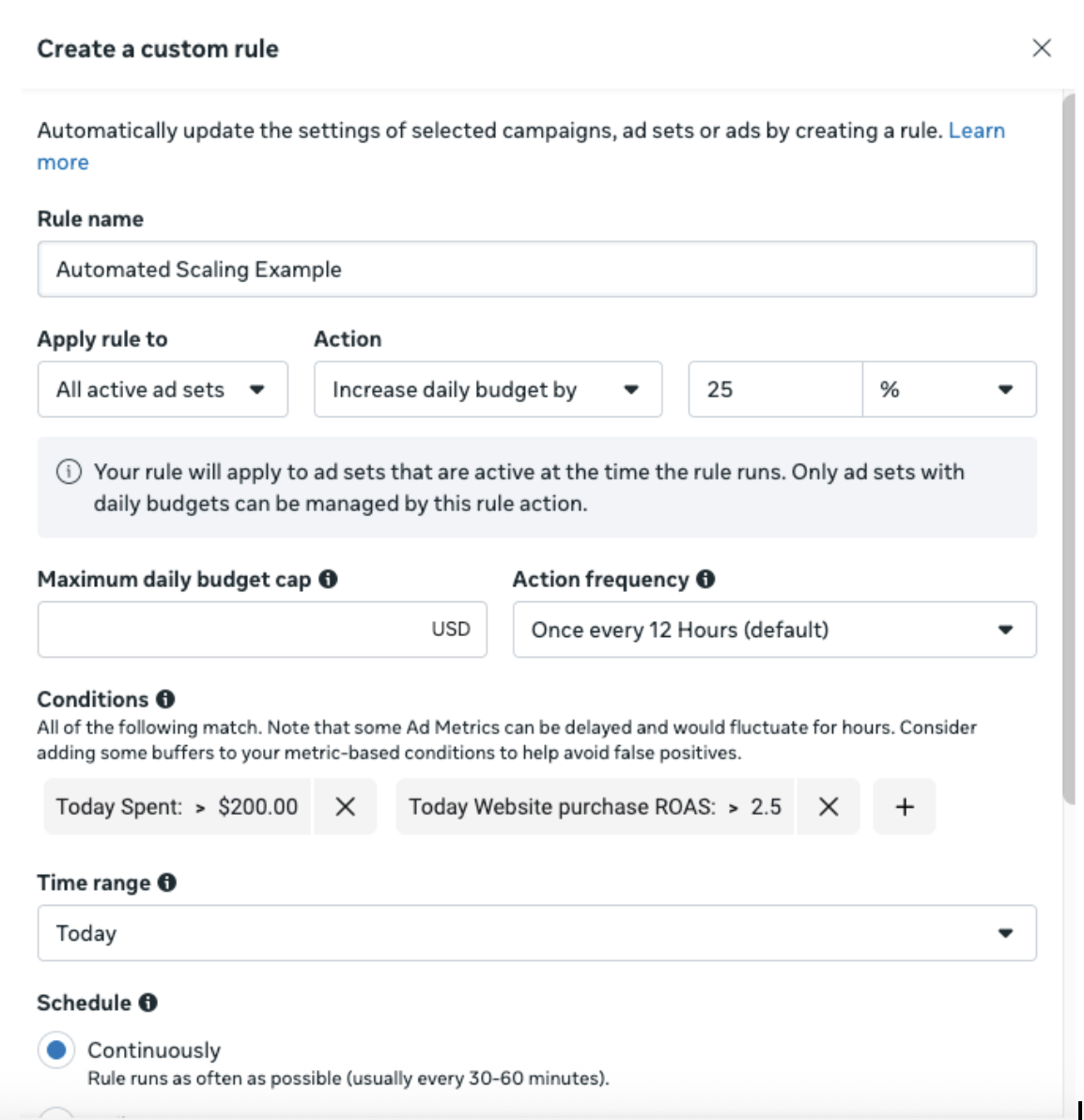
The appeal is obvious – scaling happens automatically without you needing to take action.
We have mixed feelings about this method. On one hand, it can work well for steady growth without constant manual intervention. On the other, you lose the nuance of reading the full account context. A campaign might hit your rule's criteria but the trend line is heading the wrong direction and performance is about to change. The rules only see the numbers you tell them to look at. If you do use automated rules for scaling, we'd suggest conservative percentage increases and frequent check-ins to ensure the automation isn't missing important context that would make you hold off on scaling if you were reviewing manually.
And, of course, you can always add a rule that does the opposite, lowering budget if ROAS is under your desired threshold. But, if you automate too much of the process it can start to get a little confusing, it introduces the capacity for errors, and you may lose touch with the daily rhythms of the ad account and have difficulty assessing changes.
Manual Bid Campaigns for Rapid Scale
Now let's come back to that last horizontal scaling suggestion – using bid cap or cost cap campaigns – and expand it into what is an admittedly more advanced technique for scaling, albeit one we consider the most reliable method for scaling quickly while maintaining efficiency.
The approach is to create a new manual bid campaign with a very high daily budget – high enough that you won't hit pacing issues even at your target spend level. This will almost always be more than we actually want to spend. The key is pairing this high budget with a strict bid cap or cost cap that keeps costs in line. We then populate this campaign with our proven top performers – the ads we know convert well. Initially, the campaign might not spend much at all if your cap is aggressive. That's fine. We gradually walk the bid up in small increments until we find the sweet spot where the campaign starts spending consistently while maintaining acceptable performance.
What makes this method particularly effective is that you're letting the bid cap act as your safety net rather than relying on the algorithm to maintain efficiency at higher budgets. If costs start creeping up, the campaign simply reduces delivery rather than spending inefficiently.
However, and this is very important, if you are going to try this it’s essential you use automated rules to maintain a safety net and avoid runaway spend. We looked at a rule for scaling in the last section. You can also use automated rules in this use case.
We like to set up the following rules:
Kill the campaign if it spends up to $X in a given day. Considering we are setting the daily budget higher - potentially much higher - than we actually want to spend, this will act as a ceiling and ensure we don’t spend more than we want to no matter how well things are going.
Kill the campaign if it has spent a certain amount today and results are over your desired threshold. This one is very similar in structure to the scaling rule above, but is being used to control for situations where the bid constraint isn’t acting as you intend it to.
Restart the campaign if delayed attribution comes in and it is actually under your threshold once those delayed sales come in.
Restart the campaign the next day if it was turned off the day before.
Here is what those rules look like in practice:
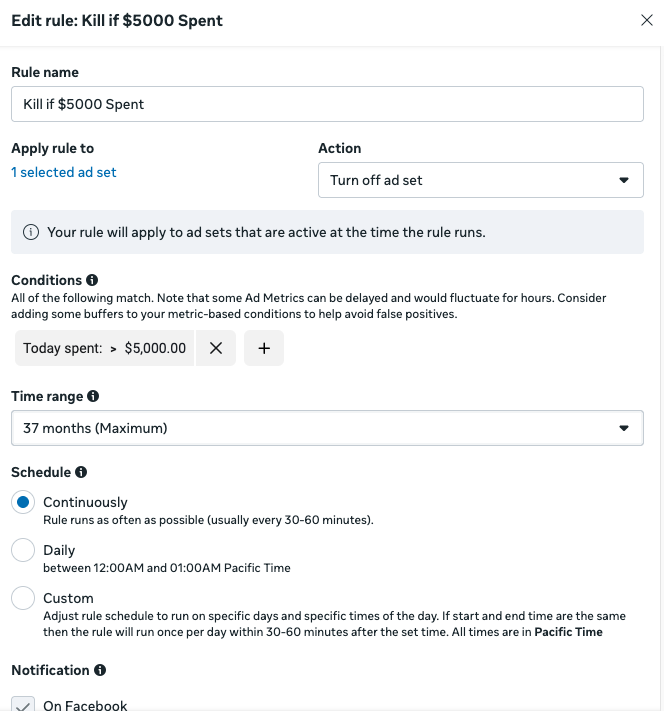
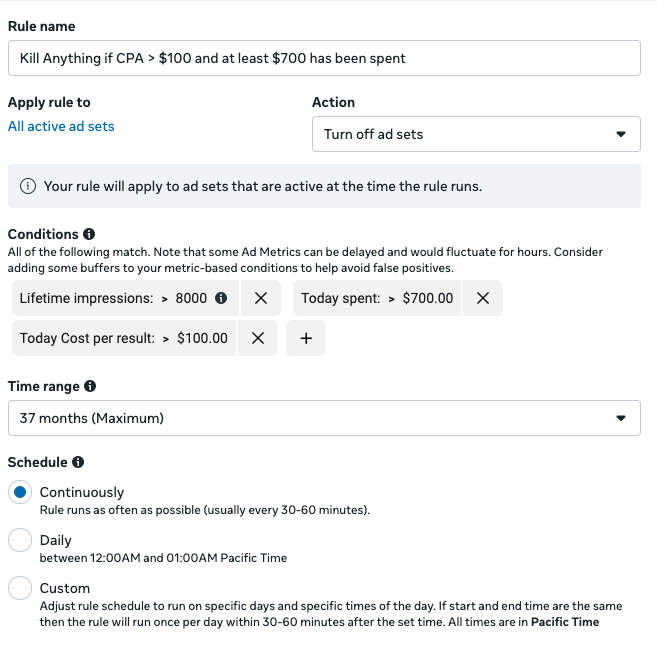
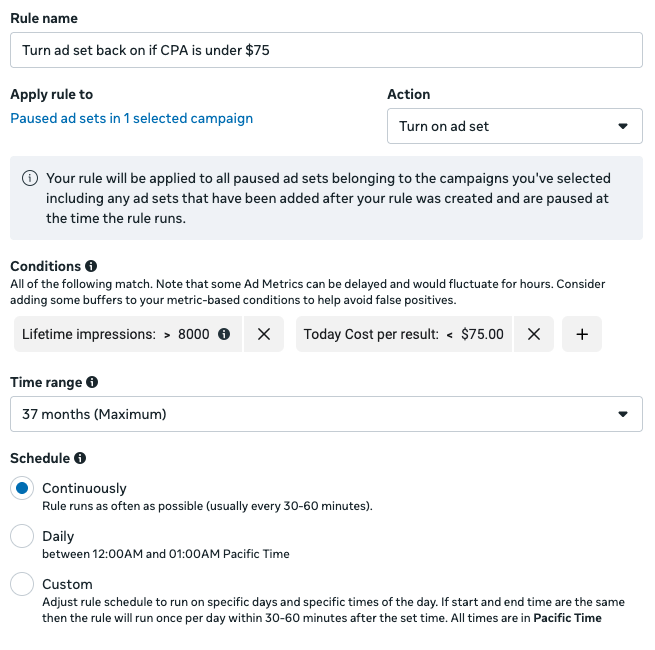
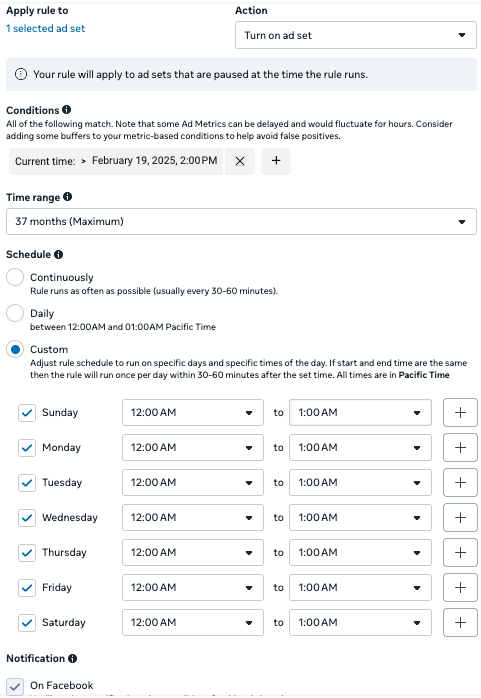
We've used this method to add $10,000-$20,000 in daily spend in a very short period of time while keeping CPAs stable. Yes, it requires active management to find and maintain that bid sweet spot, but it gives you far more control than hoping the algorithm adjusts well to a doubled budget. The biggest downside is that you need strong historical data to set appropriate caps, and you'll need to monitor closely as market conditions change.
And, be sure to use those rules! Manual bids don’t always work as intended, you will need those safeguards in place. This is an advanced technique and involves using an elevated daily budget, so there is risk involved. If you don’t feel comfortable trying it that’s OK! Use one of the other scaling methods we’ve discussed.
and get blogs just like this one sent straight to your inbox.
Conclusion
Scaling Meta ad accounts successfully comes down to matching your method to your situation. If you have time and want maximum stability, the slow and steady 20-25% increases will get you there with minimal drama. Need to move faster? Horizontal scaling gives you more control than pure budget increases, while automated rules can handle the mechanics if you set appropriate guardrails.
For those comfortable with more advanced techniques and active management, manual bid campaigns offer the fastest path to scale while maintaining efficiency – just make sure those safety rules are in place. We've scaled accounts from $1,000 to $20,000 per day using various combinations of these methods, and the truth is there's no single "right" way. Start with what feels manageable based on your experience level and situation, test more aggressive approaches if you feel comfortable doing so, and always remember that any scaling method beyond slow incremental increases involves accepting some degree of risk. The key is choosing the risk profile that matches your business needs and management capacity.
Made it this far? If so, we can’t wait for you to learn more about our Foxwell Founders Membership for digital marketers. See you there?