AI Innovations in Meta’s Ad Ranking: What Advertisers Need to Know (and Why It Matters)
Why it’s important to know:
Meta’s new AI systems, including GEM, Lattice, Andromeda, and Sequence Learning, are transforming how ads are ranked, personalized, and delivered, leading to a platform that is significantly more predictive and automated. These systems enhance performance and efficiency by aligning ads more closely with user intent, making creative and data inputs increasingly vital compared to manual optimizations. Advertisers who embrace broad targeting and automation are rewarded, as Meta evolves into a predictive engine rather than merely a reactive ad platform. In short, understanding these AI systems is essential for remaining competitive, as they now dictate what scales, what doesn’t, and why.
Meta’s AI advancements aren’t just product updates, they’re reshaping the actual foundation of how ads are ranked, personalized, and delivered. And the impact is already showing up inside accounts: greater efficiency, better relevance, higher conversion rates, and more intelligent creative matching.
Behind the scenes, Meta has quietly rebuilt major parts of its ads infrastructure with a new generation of AI models. These upgrades aren’t the flashy “try this new feature” type. They’re the invisible levers that determine who sees your ad, when they see it, and why the system chose that creative.
Here’s what’s new, what’s changed, and why it matters for anyone managing Meta ads in 2025.
1. Meta GEM: The “Super Brain” Powering Relevance
What it is:
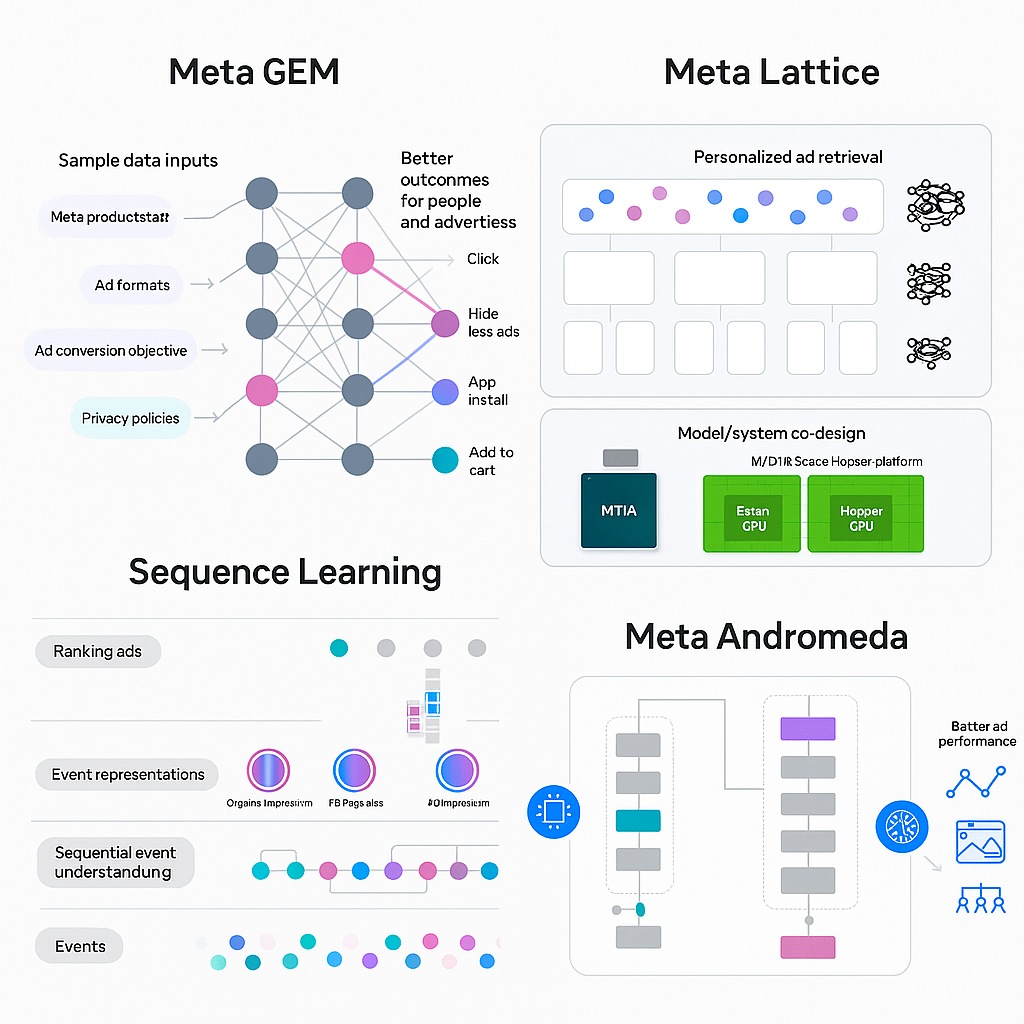
GEM (Generative Ads Recommendation Model) is Meta’s newest large scale ML model trained across thousands of GPUs. It ingests and interprets more data at higher speed than anything Meta has used before.
Think of it as the system’s new super-brain: It reads trillions of data points, understands behavioral patterns, and predicts the best possible ad to serve at the exact right moment — all with lower latency and higher accuracy.
Why advertisers should care:
Better prediction = better delivery
Better delivery = better performance
Better personalization = more qualified traffic
Performance impact:
➡️ Up to 5% increase in conversions when GEM launched across Meta Reels and Meta has now expanded GEM platform wide.
2. Meta Lattice: One Giant Library Instead of 20 Small Ones
What it is:
Historically, Meta used separate models for separate objectives and surfaces. One for leads. One for purchase. One for Reels. One for Feed. Dozens more behind the curtain.
Lattice collapses all of that into one large, interconnected “library” that learns across every objective and placement. It doesn’t just know more — it knows how things relate across the entire journey.
Why advertisers should care:
Lattice means the ads system now learns faster and more holistically:
Fewer siloed models
Stronger predictions, especially for mid- and lower-funnel actions
Better understanding of multi-touch customer journeys
Higher efficiency when running broad, dynamic creative strategies
Performance impact:
➡️ ~12% lift in ad quality
➡️ Up to 6% increase in conversions
This is arguably one of Meta’s most important backend changes in years.
3. Meta Andromeda: The Personal Concierge Running Behind the Scenes
What it is:
Andromeda is Meta’s new ML + hardware pipeline built on MTIA + NVIDIA Grace Hopper. The short version? It massively increases the complexity of models Meta can use for retrieval — the step where the system narrows millions of ads down to a few thousand. This enables Meta to pick the right creative with far more accuracy. Think of it like a concierge who knows you don’t just like shoes… but that you wear red flip-flops on vacation and trail runners on weekends.
Why advertisers should care:
As advertisers upload more creative variants, Andromeda is what helps Meta:
Match the right creative to the right person
Surface the most relevant ad faster
Increase the value of diversified creative libraries
Power Advantage+ automation with more intelligence
Performance impact:
➡️ 8% increase in ad quality
➡️ Stronger results from A+ Shopping, A+ App Campaigns, and creative GenAI
4. Sequence Learning: The “Memory Game” that Understands Journeys
What it is:
Sequence Learning allows Meta to understand the order of user actions across time before and after seeing an ad.
Instead of thinking in isolated events (click → purchase), it thinks in narratives (browse → save → add to cart → research → purchase → repurchase).
Why advertisers should care:
This is the closest Meta has ever been to understanding intent and timing.
Classic example:
If someone books a ski resort room once, the old model kept showing more resort rooms.
The new model understands the journey:
➡️ show ski gear
➡️ lift tickets
➡️ luggage
➡️ other accessories
Performance impact:
➡️ 3% increase in conversions across early testing
As privacy reduces the volume of available signals, sequence based modeling becomes essential.
So… What Does This Mean for Media Buyers Right Now?
Meta’s AI upgrades point toward a few key themes advertisers should lean into:
1. Creative volume + diversity now matter more than ever.
Because the system is better at matching creative → user → intent.
Diversification isn’t a recommendation anymore — it’s table stakes.
2. Broad targeting keeps getting smarter.
With Lattice + GEM + Andromeda powering ranking, broad audiences gain better personalization with less human intervention.
3. Advantage+ automation will continue to outperform manual controls.
These backend upgrades compound the performance of A+ Shopping, A+ App, and A+ Audience.
4. Your ad account strategy should assume Meta is becoming a predictive engine, not a reactive one.
Creative, offer, and landing page matter more than toggles and hacks.
5. First-party and post-purchase signals become increasingly valuable.
Sequence Learning rewards advertisers who feed the system clean event data.
Final Takeaway
Meta’s AI innovations aren’t just incremental tweaks, they’re rewriting the core mechanics of ad delivery. For advertisers, this means:
stronger performance
smarter personalization
more efficient spend
better creative matching
and a future where automation does more of the heavy lifting
In 2025, success on Meta will come from pairing high quality creative and strong offers with a deep understanding of how Meta’s AI systems actually evaluate, rank, and deliver ads. And the good news? These upgrades are already live and the early performance lifts speak for themselves.