The 5 Most Common Google tROAS Mistakes (and How to Avoid Them)
By Jerome Yip
Why It Matters
TROAS might seem straightforward—just turn it on and let Smart Bidding do its thing. But Jerome's insights reveal how rushing to judge it too soon or reacting too often can cause problems. Responding to early conversion signals, daily fluctuations, or a steady blended ROAS that masks shifts in delivery can lead to constant target adjustments, preventing the algorithm from settling. For media buyers with real budgets, this can mean the difference between a bidding strategy that grows steadily over time and one that’s constantly reset every time there's a bad day. The key isn't more oversight, but understanding which data is truly ready to guide decisions.
Google target ROAS bidding can work remarkably well, but only when you give it the right signal, evaluate it on the right timeline, and resist the urge to overmanage it.
After using tCPA almost exclusively for the past two years, tROAS is now my preferred Google Ads bidding strategy for higher-spend accounts where conversion values reliably reflect business value.
The challenge is that tROAS is easy to misread because results take time to mature, daily performance is noisy, and blended ROAS can hide important changes underneath.
Here are five mistakes I see most often, and what to do instead.
The five mistakes at a glance
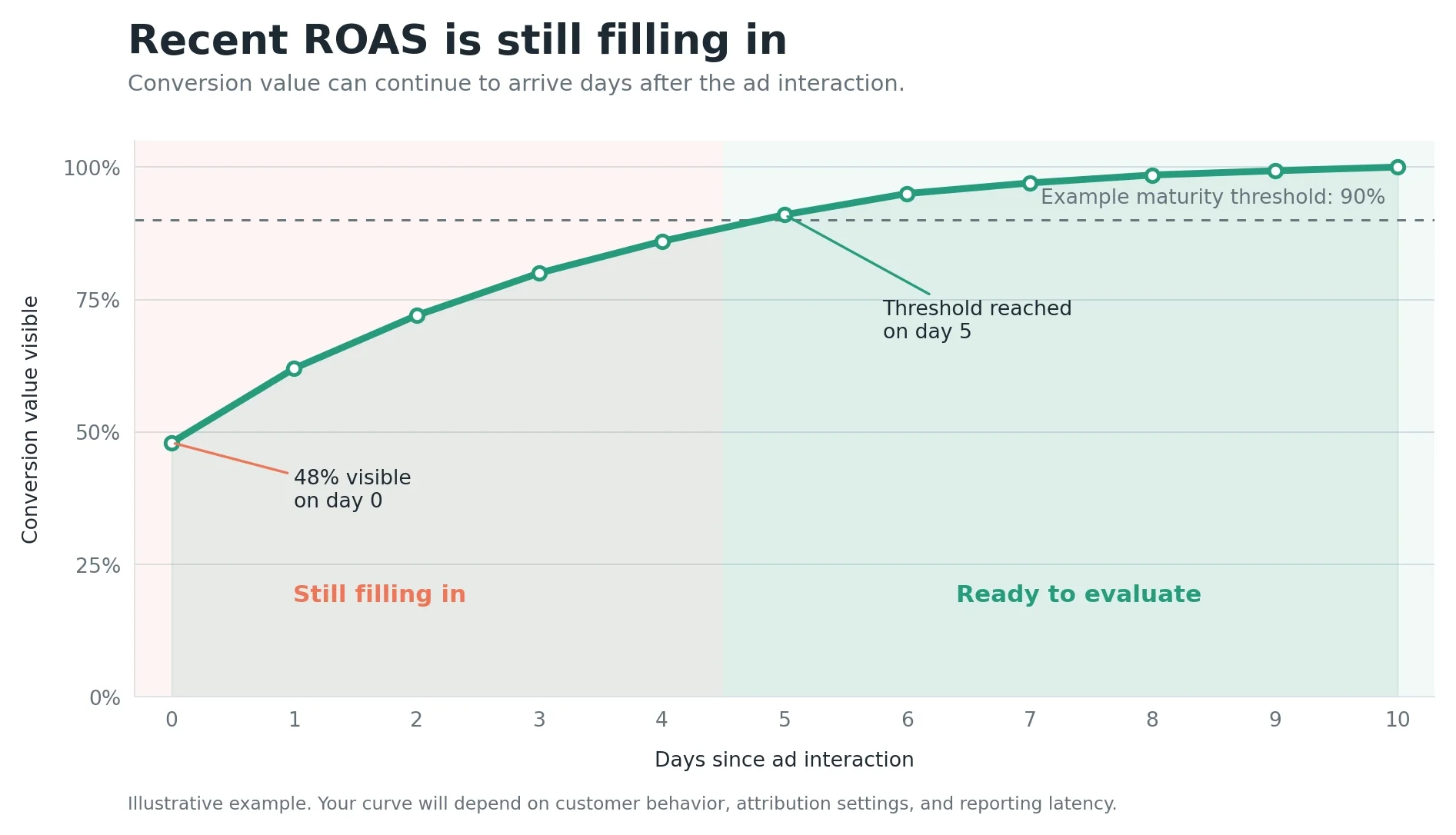
Fresh ROAS is often incomplete. Recent clicks may continue producing conversions and value for days unless you’re using a 1-day click attribution window.
More conversions do not always mean a better signal. Conversion count can rise while value per conversion falls.
Daily ROAS is noisy. It is useful for monitoring, but dangerous as the basis for frequent bidding changes.
Blended ROAS hides the mix underneath it. Similar returns can come with very different acquisition costs, volume, and inventory.
Aggressive or frequent changes make campaigns harder to evaluate. Smart Bidding needs a stable objective and enough mature data to show what is actually driving performance.
Who this is for
This is for ecommerce operators and media buyers who use Maximize conversion value or Target ROAS, especially in accounts with meaningful daily spend, long conversion journeys, offline imports, or products with widely different values.
Real numbers, real platform breakdowns, no vague "diversify your channels" advice.
1. Judging ROAS before conversion value has matured
The mistake: Treating recent ROAS as final without checking whether the underlying conversion value is complete.
Why it hurts: Unless you use a one-day click attribution window, a conversion may happen well after the original ad interaction. It may take even longer to appear in Google Ads because of reporting delays or the timing of offline uploads.
That means recent cohorts’ conversion values are often incomplete. A dashboard may show weak ROAS today, only for additional conversions and conversion value to arrive over the next several days. If you react too early, you may change a campaign that was moving toward the right result.
The right waiting period is not universal. It depends on your conversion window, the time customers take to convert, and how quickly your data reaches Google Ads.
What to do instead:
Document the conversion window for every primary conversion action.
Measure how quickly conversion value becomes visible after the ad interaction.
Choose a maturity threshold that matches your tolerance for incomplete data.
Exclude newer cohorts from performance decisions until enough value has arrived.
The goal is not to wait forever. It is to know which dates are ready to evaluate and which are still developing.
Hint: Google Ads provides a detailed breakdown of the time between a person’s first ad exposure and conversion. In Google Ads, go to Goals → Measurement → Attribution → Path metric → Select your conversion action and your lookback window.
2. Assuming more conversions mean a better signal
The mistake: Treating conversion count as proof that Smart Bidding has enough high-quality information.
Why it hurts: More feedback is useful only when that feedback represents the outcome you actually care about.
A campaign can generate more conversions while value per conversion falls. A few unusually large purchases can also make ROAS appear stronger than the underlying pattern. At the other extreme, many low-value conversions can dominate the count without contributing enough economic value.
This matters most when product prices or customer values vary widely. tROAS is designed to use those differences, but the overall result can still become unstable when too much value depends on a small number of outcomes.
What to do instead:
Evaluate only mature conversions.
Track median value per conversion, not just the average.
Check how much total value comes from the largest conversions.
Group conversions into value bands and monitor each band’s share of count and value.
Where possible, optimize toward margin-adjusted value rather than raw revenue.
You are looking for a signal that has enough observations and represents meaningful business value.
3. Reacting to daily ROAS
The mistake: Raising or lowering the target because of one or two strong or weak days.
Why it hurts: Daily ROAS can move sharply even when the bidding strategy is performing normally over a longer horizon. If you respond to every swing, you risk turning ordinary noise into a sequence of unnecessary changes.
Daily data still matters. It can reveal broken tracking, stopped delivery, sudden spend changes, conversion-rate drops, and genuine anomalies. It is simply the wrong view for deciding whether tROAS has found its target.
What to do instead: Maintain two views of the account.
Daily monitoring: Look for tracking problems, delivery interruptions, sharp volume changes, and other operational issues.
Performance evaluation: Judge results using a rolling window that contains only mature conversion value.
In the accounts I’ve managed, a useful starting point has been to evaluate two full attribution-window cycles of mature data. For example, if you use a seven-day click attribution window and today is September 15, review the preceding 14 days ending no later than September 8. Move the cutoff earlier if reporting or offline uploads introduce additional delays.
Calculate rolling ROAS by dividing total conversion value by total spend across that period. Do not average daily ROAS percentages. That gives low-spend days the same weight as high-spend days and can distort the result. Compare the result with the target that was active during the same period.
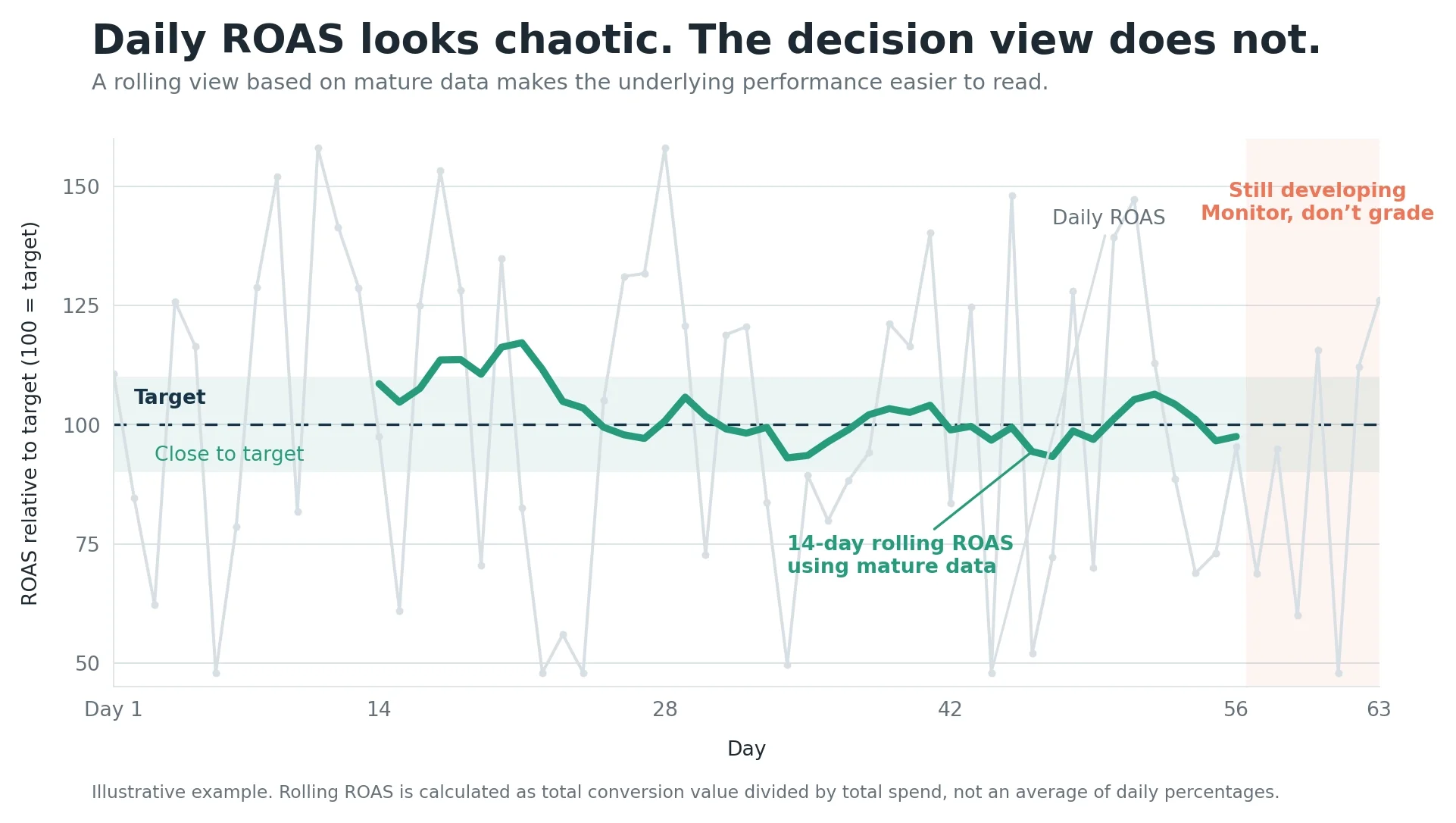
After a material change, set the earliest date when you expect the result to be mature enough to evaluate. Until then, monitor the transition without grading it.
Want more than just insights? Join the community behind them
4. Looking only at blended ROAS
The mistake: Assuming that similar blended ROAS means the campaign is driving the same kind of growth.
Why it hurts: Moving from conversion-count bidding to value-based bidding changes what Google is trying to buy. Instead of treating every conversion similarly, the bidder predicts which auctions are more likely to produce higher value.
That can change ad group delivery, placements, audiences, products, acquisition costs, and volume. Google may pay more for an impression when it expects the resulting conversion to be worth more. Lower-value products may also receive less delivery when other products offer more expected value or more scalable opportunities at the target.
None of those changes is automatically good or bad. The problem is that blended ROAS can hide them, and the new delivery mix may take months to become obvious.
What to do instead: Record your delivery mix and unit economics before changing the bidding objective. Once the post-change data has matured, compare:
spend by placement, audience, product, and geography;
cost per conversion and value per conversion;
conversion volume and segment-level ROAS or margin; and
concentration of spend and value across placements or products.
Then ask whether the new mix still supports the business objective. A stable blended ROAS is only the beginning of that assessment.
5. Setting an aggressive target or changing it too often
The mistake: Setting an aspirational tROAS target before the campaign has established stable value-based performance, then changing the target or conversion goal before the previous change can be evaluated.
Why it hurts: An overly aggressive target can constrain delivery by narrowing the auctions Google is willing to enter. Frequent target or conversion-goal changes make the problem harder to diagnose because the bidder must keep adapting while the reporting window mixes results from several different settings.
What to do instead:
Start with Maximize conversion value without a tROAS target.
Let it run for at least one full attribution-window cycle, ideally longer, until the mature data show stable spend, volume, ROAS, and value per conversion.
Set the first tROAS close to that demonstrated performance, not the longer-term aspiration.
Move toward the longer-term goal in measured steps.
Give the results of every material change enough time to mature before evaluating them.
Changing the primary conversion goal requires even more care because it changes the signal itself. Treat it as a migration: validate the new goal, build goal-specific history where possible, roll it out gradually, and preserve a rollback path.
Six years of Slack debate from 500+ paid-media operators, now queryable from inside Claude or Cursor. No seat in the community required.
A tROAS readiness and review checklist
Define your maturity cutoff. Document the attribution window and reporting delays, then identify the newest date whose performance is ready to evaluate.
Check the quality of the signal. Confirm that value is supported by enough conversions and is not dominated by a few outliers.
Calculate rolling ROAS from mature data. Divide total conversion value by total spend across the evaluation period.
Audit what Google is buying. Compare delivery mix, volume, and unit economics with the period before value-based bidding.
Establish a stable baseline before setting tROAS. Set the initial target near demonstrated performance, then give each change a protected evaluation window.
Final takeaway
Google tROAS bidding generally does what it is asked to do. The harder part is knowing whether the evidence is ready to act on.
Make sure conversion value is mature and supported by enough meaningful observations. Use daily data to monitor operations, but use rolling ROAS calculated from mature data to evaluate performance. Look beneath blended ROAS to see how bidding changes delivery and unit economics. Establish a stable value-based baseline, set targets close to demonstrated performance, and give the bidder enough time to adapt to each change.
The question is not simply how many days or conversions Google needs. It is whether the conversion value is mature, the signal is meaningful, and performance has been stable over a long enough window to support a decision.
Want to learn more? Reach out to Jerome Yip at jerome@kgp.studio