Is Detailed Targeting Dead? What Foxwell Members Are Seeing Post-Andromeda
The audience skills that defined media buying for a decade have stopped being the job
Why It Matters
For a decade, the thing that separated a good Meta media buyer from a great one was building a quality audience. You stacked interests, layered behaviors, added a demographic filter, and excluded warm lists so you weren't paying to reach people who already knew you.
Then Andromeda moved the ground under everyone at once. As Rok Hladnik put it on LinkedIn, Meta moved media-buying control upstream. Targeting and bidding matter far less now, and the range of creative signals you feed the system matters far more. If your tight, well-researched targeting is getting beaten by a broad ad set you built in 30 seconds, that’s because the rules have changed.
Who This Is For
This is for Meta advertising pros who came up learning real audience craft and now feel like it is being taken away. If you run meaningful Meta spend for DTC or ecommerce brands and have a folder of saved audiences you spent years refining, this is for you. It’s also for anyone whose account behaved strangely this past week and couldn’t tell whether it was the creative, the offer, the tracking, or something Meta did without announcing it.
TL;DR: Detailed targeting isn’t dead, but it works differently. The real story isn’t about audiences at all anymore.
Meta Became a Creative Matching Engine
Andromeda has inverted the whole logic of delivery. The old system asked who should see this ad, found those people, then picked a creative for them. Andromeda paired with GEM asks a different question: Which ad should this specific person see right now?
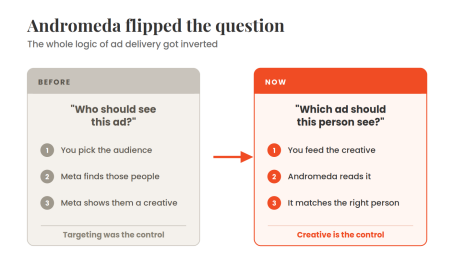
The system now reads every user action in real time to match ads to buyers. This leverages Meta’s understanding of behavioral patterns over time, like who clicked what three months ago and what they browsed yesterday, then matching that against your creative. That one change explains everything downstream. If all your ads say the same thing in slightly different ways, you are capped, because GEM buckets similar creatives together and makes them compete for the same pool of people. Creative diversity has taken over as your growth lever.
What Members Are Seeing Now
Starting around September 17, multiple Foxwell Founders members flagged account disruption. CPMs dropped roughly 30 percent across accounts in several countries, which sounds like good news except that CTRs and purchases fell at the same time. The lower cost was pulling in lower-quality audiences.
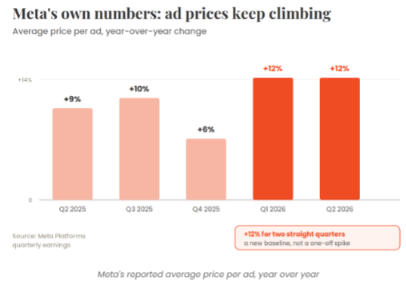
The climb is steady and well documented. Average price per ad rose 9 percent year over year in Q2 2025 and 10 percent in Q3, then landed at 12 percent in both Q1 and Q2 2026, the second straight quarter at that level and what analysts now treat as a new baseline rather than a spike. Impressions grew right alongside it, up 19 percent year over year in Q1 2026, so Meta is serving more inventory and still charging more for it. On a recent Brand Owners call, operators tied the quarter-to-quarter choppiness to Meta shipping big backend updates right before Q4 with less headcount inside to help advertisers through it. So if your numbers moved on you, you are most likely feeling a market that is both pricier and mid-transition, not a broken account.
Your inbox deserves better.
Get the Foxwell Digital Download: practical, tested performance marketing ideas, straight from the team that lives it.
What’s Working: True Creative Diversity
This is the one point the whole community agrees on: creative diversity is what’s driving growth.
On the video side that means format diversity including AI animations, UGC, street interviews, and TikTok Shop content repurposed for feed. On the static side, it means going past color swaps into native Q&A; images, comparison layouts, problem and solution treatments, and minimalist versus maximalist looks.
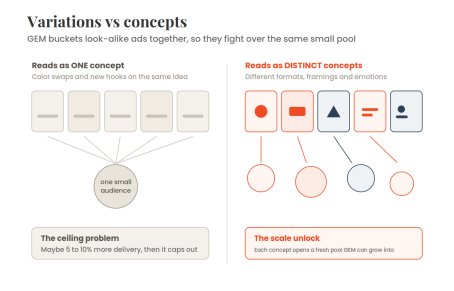
Why near-identical ads cap out while distinct concepts scale
When your five ads share an idea with minimal variation, GEM treats them as one concept and funnels them all toward one small audience, which is why you hit a ceiling so fast. When they are genuinely different concepts, each opens a fresh pocket of people to grow into. Diversity that goes beyond style is how you access a bigger audience.
The Sub-Avatar Shift
Daniel Okon, the CEO of ACTIV, reframes the whole targeting question. Instead of building around broad demographics, you build around sub-avatars, meaning specific behaviors and specific pains. If the old brief included women 25 to 45 interested in wellness and handed the buyer the job of finding them, the new brief should talk about bloating after pizza and give GEM the job of finding whoever that describes. Write the creative for the pain and let the machine match it to the human.

His practical tip is to research your organic content first. Look at what’s performing on Instagram and model your ads accordingly.
Six years of Slack debate from 500+ paid-media operators, now queryable from inside Claude or Cursor. No seat in the community required.
What Stopped Working
A few old habits can hold today’s accounts back. Duplicating a winner with minor tweaks gets bucketed as the same concept and hands you maybe 5 to 10 percent more delivery instead of scale. Running the same handful of templates on rotation gets you deprioritized in favor of accounts feeding more variety. And launching ten ads with everything different at once leaves you with no idea what moved the needle. The goal is to build genuine variety you can learn from. As Courtney Fritts put it in the Foxwell blog, GEM has redefined the job of the creative strategist.
The Tactical Shift
Think in concepts instead of variations, meaning different emotional triggers, problem framings, and belief systems, not new hooks on the same video. Use Meta's new Push Delivery feature to force spend onto fresh ads inside a live campaign, which fixes the old problem of new ads sitting at zero while proven winners eat the budget. Watch the
Creative Diversity metric Meta added, and expect it to be harsh. And brief for sub-avatars, because the more granular the pain, the more distinct audiences GEM can find.
So, Is Detailed Targeting Dead?
No, but the truth is more useful than the headline. Detailed targeting isn’t the thing you build your account and expertise around anymore, because Meta treats your interest inputs as suggestions and already holds a richer picture of every user than any stack you could build by hand. Your creative range and customer understanding now do the job your saved audiences used to.
The operators pulling ahead stopped grieving the old playbook and started feeding the new one, with genuine creative diversity, sharp sub-avatar briefs, and a library built before the season instead of during it. With BFCM bearing down, time is of the essence; the algorithm needs runway to learn across your concepts before you scale them. The accounts walking into October with a deep, varied library have a Q4 advantage.
This piece pulls from what Foxwell Founders members have reported across Slack, community calls, and LinkedIn since the Andromeda rollout, including the Scalability School deep-dive. Specifics vary by brand, category, and account maturity. Test against your own numbers before you commit budget.
Disclaimer: this article was created with the assistance of AI and reviewed and edited by a human before publishing.